
|
You entered: constellation
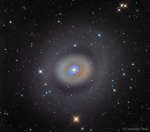 Starburst Galaxy M94
25.05.2015
What could cause the center of M94 to be so bright? Spiral galaxy M94 has a ring of newly formed stars surrounding its nucleus, giving it not only an unusual appearance but also a strong interior glow.
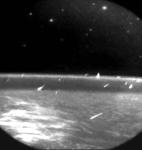 Leonids from Orbit
28.11.2000
Here is what a meteor shower looks like from orbit. During the peak of the 1997 Leonid Meteor Shower, the MSX satellite imaged from above 29 meteors over a 48 minute period entering the Earth's atmosphere. From above, meteors create short bright streaks.
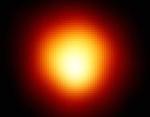 Betelgeuse, Betelgeuse, Betelgeuse
5.06.1999
Betelgeuse (sounds a lot like "beetle juice"), a red supergiant star about 600 light years distant, is seen in this Hubble Space Telescope image - the first direct picture of the surface of a star other than the Sun. While Betelgeuse is cooler than the Sun, it is more massive and over 1000 times larger.
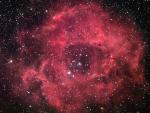 The Rosette Nebula
13.02.2001
Would the Rosette Nebula by any other name look as sweet? The bland New General Catalog designation of NGC 2237 doesn't appear to diminish the appearance of the this flowery emission nebula. Inside the nebula lies an open cluster of bright young stars designated NGC 2244.
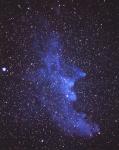 The Witch Head Nebula
8.02.1998
Double, double toil and trouble; Fire burn, and cauldron bubble ... Maybe Macbeth should have consulted the Witch Head Nebula. This suggestively shaped reflection nebula is associated with the bright star Rigel in the constellation Orion. More formally known as IC 2118, the Witch Head Nebula glows primarily by light reflected from Rigel.
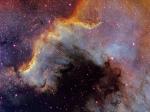 The Cygnus Wall of Star Formation
21.06.2005
The North America Nebula in the sky can do what North Americans on Earth cannot -- form stars. Specifically, in analogy to the Earth-confined continent, the bright part that appears as Central America and Mexico is actually a hot bed of gas, dust, and newly formed stars known as the Cygnus Wall.
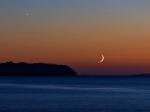 Moon River
9.09.2005
Shortly after sunset on September 6th, sky gazers around the world were treated to a lovely crescent Moon in western skies -- joined by bright planets Venus and Jupiter. In this colorful telephoto view from near Quebec City, Canada the Moon is nestled just above the wide St. Lawrence River.
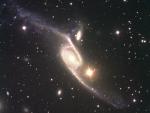 NGC 6872: A Stretched Spiral
25.05.1999
What makes NGC 6872 so long? Measuring over 700,000 light years across from top to bottom, NGC 6872 is one of the largest barred spiral galaxies known. The galaxy's elongated shape might have something to do with its continuing collision with the smaller galaxy IC 4970, visible just above center.
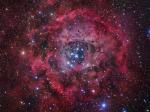 The Rosette Nebula
13.02.2007
Would the Rosette Nebula by any other name look as sweet? The bland New General Catalog designation of NGC 2237 doesn't appear to diminish the appearance of the this flowery emission nebula. Inside the nebula lies an open cluster of bright young stars designated NGC 2244.
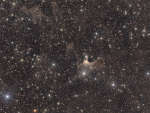 Haunting the Cepheus Flare
29.10.2008
Spooky shapes seem to haunt this starry expanse, drifting through the night in the royal constellation Cepheus. Of course, the shapes are cosmic dust clouds faintly visible in dimly reflected starlight. Far from your...
|
January February |
|||||||||||||||||||||||||||||||||||||||||||||||||