
|
You entered: Total eclipse
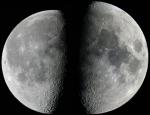 Apogee Moon, Perigee Moon
21.10.2004
Why don't these pieces fit? This third quarter Moon (left) and first quarter Moon were both photographed during the last lunar cycle or lunation with the same telescope and camera. But, simply combining the pictures into one sharp, full surface view would clearly be a problem.
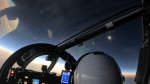 APOD: 2026 September 5 Б Chasing the Moon s Shadow
5.09.2026
Chasing the shadow of a New Moon, NASAБs WB-57F high altitude research aircraft took to the skies off the coast of Iceland on August 12 to observe a total solar eclipse. At 50,000 feet the aircraft was piloted along the precisely determined path of totality to maximize its time in the MoonБs shadow.
 Ring of Fire over Easter Island
11.10.2024
The second solar eclipse of 2024 began in the Pacific. On October 2nd the Moon's shadow swept from west to east, with an annular eclipse visible along a narrow antumbral shadow path tracking...
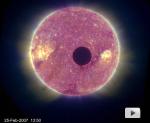 Lunar Transit from STEREO
3.03.2007
A million miles from planet Earth, last weekend the STEREO B spacecraft found itself in the shadow of the Moon. So, looking toward the Sun, extreme ultraviolet cameras onboard STEREO B were able to record a stunning movie of a lunar transit (aka solar eclipse), as the Moon tracked across the solar disk.
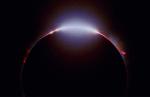 Madagascar Totality
26.07.2001
When the Moon's shadow reached out and touched Earth's southern hemisphere on 2001 June 21, the first total solar eclipse of the 21st century began. Starting in the Atlantic, the dark, central...
 Sunshine, Earthshine
19.03.2015
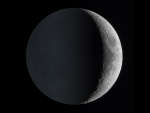
Today's date marks an Equinox and a New Moon. Remarkably, while the exact timing of both geocentric events occur within a span of only 13 hours, the moon also reaches its new phase only 14 hours after perigee, the closest point in its orbit.
 Highlights of the Summer Sky
5.06.2017
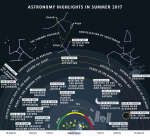
What's up in the sky this summer? The featured graphic gives a few highlights for Earth's northern hemisphere. Viewed as a clock face centered at the bottom, early summer sky events fan out toward the left, while late summer events are projected toward the right.
 Moon Shadow versus Sun Reflection
17.07.2017
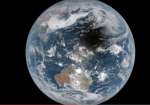
What are those lights and shadows crossing the Earth? As the featured five-second time-lapse video progresses, a full day on planet Earth is depicted as seen from Japan's Himawari-8 satellite in geostationary orbit high above the Pacific Ocean.
 The Umbra of Earth
15.12.2011
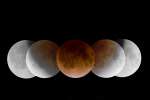
The dark, inner shadow of planet Earth is called the umbra. Shaped like a cone extending into space, it has a circular cross section most easily seen during a lunar eclipse. For example, last Saturday the Full Moon slid across the southern half of Earth's umbral shadow, entertaining moonwatchers around much of the planet.
 Zubenelgenubi and Friends
14.05.2004
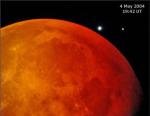
Moderately bright Zubenelgenubi is the star just off the upper right hand limb of an eclipsed Moon in this telescopic view from Port Elizabeth, South Africa. Actually the second brightest star in the constellation...
|
January February March April May June July August September October |
|||||||||||||||||||||||||||||||||||||||||||||||||