
|
You entered: star
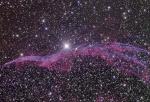 NGC 6960: The Witch's Broom Nebula
1.01.2003
Ten thousand years ago, before the dawn of recorded human history, a new light must suddenly have appeared in the night sky and faded after a few weeks. Today we know this light was an exploding star and record the colorful expanding cloud as the Veil Nebula.
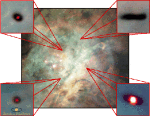 Planetary Systems Now Forming in Orion
7.12.1996
How do planets form? Astronomers are finding out by studying one of the most interesting of all astronomical nebulae known, the Great Nebula in Orion. Insets to above mosaic show several planetary systems in formation. The bottom left insert shows the relative size of our own Solar System. The Orion Nebula contains many stellar nurseries.
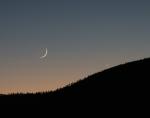 Venus and the 37 Hour Moon
25.12.2003
At Table Mountain Observatory, near Wrightwood California, USA on October 26, wild fires were approaching from the east. But looking toward the west just after sunset, astronomer James Young could still enjoy this comforting view of a young crescent Moon and brilliant Venus through the the fading twilight. Setting over the horizon of Mt.
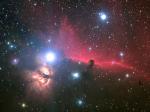 Orions Horsehead Nebula
21.03.2005
The Horsehead Nebula is one of the most famous nebulae on the sky. It is visible as the dark indentation to the red emission nebula seen above and to the right of center in the above photograph. The bright star on the left is located in the belt of the familiar constellation of Orion.
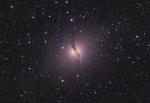 Jumbled Galaxy Centaurus A
30.06.2007
At the center of this sharp skyscape, Centaurus A seems to be a fantastic jumble of old yellow stars, young blue star clusters, and imposing dark dust lanes. Spanning over 60,000 light-years, the peculiar elliptical galaxy is apparently the result of a collision of two otherwise normal galaxies.
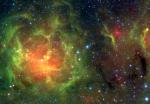 Infrared Trifid
7.07.2007
The Trifid Nebula, aka Messier 20, is easy to find with a small telescope, a well known stop in the nebula rich constellation Sagittarius. But where visible light pictures show the nebula divided into three parts by dark, obscuring dust lanes, this penetrating infrared image reveals filaments of glowing dust clouds and newborn stars.
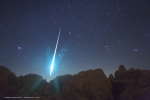 Mojave Desert Fireball
17.12.2009
Monstrously bright, this fireball meteor lit up the Mojave Desert sky Monday morning, part of this year's impressive Geminid meteor shower. Seen toward the southwest over rock formations near Victorville, California, a more familiar celestial background was momentarily washed out by the meteor's flash.
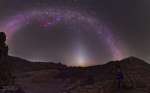 Zodiacal Light Vs. Milky Way
20.03.2010
Ghostly Zodiacal light, featured near the center of this remarkable panorama, is produced as sunlight is scattered by dust in the Solar System's ecliptic plane. In the weeks surrounding the March equinox (today...
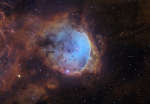 NGC 3324 in Carina
6.04.2018
This bright cosmic cloud was sculpted by stellar winds and radiation from the hot young stars of open cluster NGC 3324. With dust clouds in silhouette against its glowing atomic gas, the pocket-shaped star-forming region actually spans about 35 light-years. It lies some 7,500 light-years away toward the nebula rich southern constellation Carina.
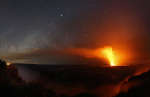 Jupiter Season, Hawaiian Sky
2.06.2018
Volcanic activity on the Big Island of Hawaii has increased since this Hawaiian night skyscape was recorded earlier this year. Recent vents and lava flows are about 30 kilometers to the east, the direction...
|
January February March April May June July August September |
|||||||||||||||||||||||||||||||||||||||||||||||||