
|
You entered: Earth
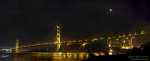 A Golden Gate Eclipse
9.04.2015
Shadows play on the water and in the sky in this panoramic view of the April 4 total lunar eclipse over San Francisco's Golden Gate Bridge. Just within planet Earth's shadow the Full Moon's disk is still easy to spot at its brief total phase.
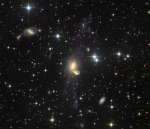 Recycling NGC 5291
21.11.2015
Following an ancient galaxy-galaxy collision 200 million light-years from Earth, debris from a gas-rich galaxy, NGC 5291, was flung far into intergalactic space. NGC 5291 and the likely interloper, also known as the "Seashell" galaxy, are captured near the center of this spectacular scene.
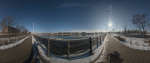 Blue Danube Analemma
29.07.2016
The Sun's annual waltz through planet Earth's sky forms a graceful curve known as an analemma. The analemma's figure 8 shape is tipped vertically at far right in this well-composed fisheye view from Budapest, Hungary.
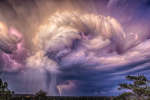 Lightning over Colorado
5.12.2016
Have you ever watched a lightning storm in awe? Join the crowd. Oddly, nobody knows exactly how lightning is produced. What is known is that charges slowly separate in some clouds causing rapid electrical discharges (lightning), but how electrical charges get separated in clouds remains a topic of much research.
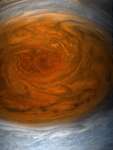 Close up of the Great Red Spot
15.07.2017
On July 11, the Juno spacecraft once again swung near to Jupiter's turbulent cloud tops in its looping 53 day orbit around the Solar System's ruling gas giant. About 11 minutes after perijove 7, its closest approach on this orbit, it passed directly above Jupiter's Great Red Spot.
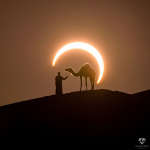 Solar Eclipse over the UAE
10.02.2020
What's happening behind that camel? A partial eclipse of the Sun. About six and a half weeks ago, the Moon passed completely in front of the Sun as seen from a narrow band on the Earth.
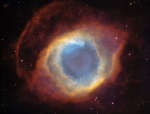 The Helix Nebula from Blanco and Hubble
23.08.2020
How did a star create the Helix nebula? The shapes of planetary nebula like the Helix are important because they likely hold clues to how stars like the Sun end their lives. Observations...
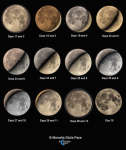 Moon Pairs and the Synodic Month
26.09.2020
Observe the Moon each night and its visible sunlit portion will gradually change. In phases progressing from New Moon to Full Moon to New Moon again, a lunar cycle or synodic month is completed in about 29.5 days.
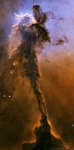 The Fairy of Eagle Nebula
25.09.2022
The dust sculptures of the Eagle Nebula are evaporating. As powerful starlight whittles away these cool cosmic mountains, the statuesque pillars that remain might be imagined as mythical beasts. Featured here is one of several striking dust pillars of the Eagle Nebula that might be described as a gigantic alien fairy.
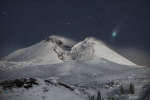 Comet ZTF over Mount Etna
28.01.2023
Comet-like plumes are blowing over the volcanic peaks of Mount Etna in this wintry mountain-and-skyscape from planet Earth. The stacked and blended combination of individual exposures recorded during the cold night of January 23, also capture naked-eye Comet ZTF just above Etna's snowy slopes.
|
January February March April May June July August September October |
|||||||||||||||||||||||||||||||||||||||||||||||||