
|
You entered: NASA
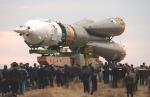 Rollout of Soyuz TMA 2 Aboard an R7 Rocket
9.10.2005
It takes a big rocket to go into space. In 2003 April, this huge Russian rocket was launched toward Earth-orbiting International Space Station (ISS), carrying two astronauts who will make up the new Expedition 7 crew.
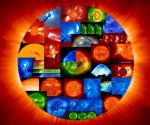 SOHO s Uninterrupted View of the Sun
1.12.2005
Launched ten years ago this week, SOHO (the SOlar and Heliospheric Observatory) still enjoys an uninterrupted view of the Sun. Twelve sungazing instruments on board the spacecraft have explored the Sun's internal structure...
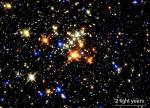 The Quintuplet Star Cluster
21.09.1999
Bright clusters of stars form and disperse near the center of our Galaxy. Four million years ago the Quintuplet Cluster, pictured above, formed and is now slowly dispersing. The Quintuplet Cluster is located within 100 light-years of the Galactic center, and is home to the brightest star yet cataloged in our Galaxy: the Pistol Star.
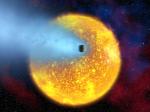 Water Claimed in Evaporating Planet HD 209458b
17.04.2007
Planet HD 209458b is evaporating. It is so close to its parent star that its heated atmosphere is simply expanding away into space. Some astronomers studying this distant planetary system now believe they have detected water vapor among the gases being liberated.
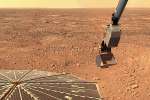 Phoenix Digs for Clues on Mars
15.06.2008
What's a good recipe for preparing Martian soil? Start by filling your robot's scoop a bit less than half way. Next, dump your Martian soil into one of your TEGA ovens, being sure to watch out for clumping. Then, slowly increase the temperature to over 1000 degrees Celsius over several days.
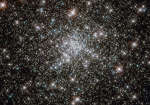 At the Core of NGC 6752
10.02.2012
This sharp Hubble Space Telescope view looks deep into NGC 6752. Some 13,000 light-years away toward the southern constellation Pavo, the globular star cluster roams the halo of our Milky Way galaxy. Over...
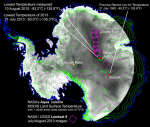 The Coldest Place on Earth
11.12.2013
How cold can it get on Earth? In the interior of the Antarctica, a record low temperature of -93.2 C (-135.8 F) has been recorded. This is about 25 C (45 F) colder than the coldest lows noted for any place humans live permanently.
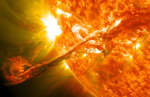 A Solar Filament Erupts
20.07.2014
What's happened to our Sun? Nothing very unusual -- it just threw a filament. Toward the middle of 2012, a long standing solar filament suddenly erupted into space producing an energetic Coronal Mass Ejection (CME).
 Infrared Orion from WISE
18.01.2015
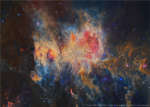
The Great Nebula in Orion is an intriguing place. Visible to the unaided eye, it appears as a small fuzzy patch in the constellation of Orion. But this image, an illusory-color four-panel mosaic taken...
 A Solar Filament Erupts
16.09.2018
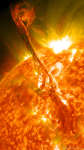
What's happened to our Sun? Nothing very unusual -- it just threw a filament. Toward the middle of 2012, a long standing solar filament suddenly erupted into space producing an energetic Coronal Mass Ejection (CME).
|
January February |
|||||||||||||||||||||||||||||||||||||||||||||||||