
|
You entered: stars
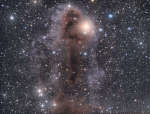 Lynds Dark Nebula 1251
31.05.2019
Stars are forming in Lynds Dark Nebula (LDN) 1251. About 1,000 light-years away and drifting above the plane of our Milky Way galaxy, the dusty molecular cloud is part of a complex of dark nebulae mapped toward the Cepheus flare region.
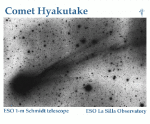 Here Comes Comet Hyakutake
13.03.1996
The reaction of ancient peoples to the appearance of bright comets has toppled empires, de-throned kings, and been taken as a sign of great things to come. Probably some of these comets did not get as bright as Comet Hyakutake ("hyah-koo-tah-kay") will in the next two weeks.
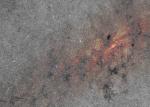 The Galactic Center in Infrared
8.07.2001
The center of our Galaxy is a busy place. In visible light, much of the Galactic Center is obscured by opaque dust. In infrared light, however, dust glows more and obscures less, allowing nearly one million stars to be recorded in the above photograph.
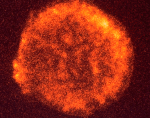 Tycho's Supernova Remnant in X-ray
23.06.1996
How often do stars explode? By looking at external galaxies, astronomers can guess that these events, known as a supernovae, should occur about once every 30 years in a typical spiral galaxy like our MilkyWay.
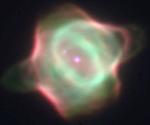 Hen 1357: New Born Nebula
3.04.1998
This Hubble Space Telescope picture shows Hen-1357, the youngest known planetary nebula. Graceful, gentle curves and symmetry suggest its popular name - The Stingray Nebula. Observations in the 1970s detected no nebular material, but this image from March 1996 clearly shows the Stingray's emerging bubbles and rings of shocked and ionized gas.
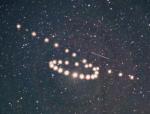 Retrograde Mars
16.12.2003
Why would Mars appear to move backwards? Most of the time, the apparent motion of Mars in Earth's sky is in one direction, slow but steady in front of the far distant stars. About every two years, however, the Earth passes Mars as they orbit around the Sun.
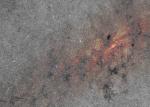 The Galactic Center in Infrared
7.11.2004
The center of our Galaxy is a busy place. In visible light, much of the Galactic Center is obscured by opaque dust. In infrared light, however, dust glows more and obscures less, allowing nearly one million stars to be recorded in the above photograph.
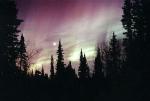 Aurora Through a Moonlit Sky
2.11.1999
A night sky can glow in fascinating ways. Through a clearing in the woods, the pictured sky above Alaska shines by reflected light from a nearby city, by the brightness of the Moon, and by aurora.
 June s Young Crescent Moon
7.06.2008
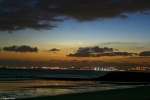
Serene skyviews were enjoyed across planet Earth earlier this week with a young crescent Moon low in the western sky just after sunset. Recorded on June 4, this colorful example includes a quiet beach in the foreground with the city lights of Lisbon, Portugal, and the Sintra Mountains along the horizon.
 IC 1396: Emission Nebula in Cepheus
5.08.2012
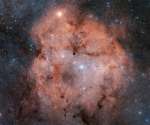
Stunning emission nebula IC 1396 mixes glowing cosmic gas and dark dust clouds in the high and far off constellation of Cepheus. Energized by the bright, bluish central star seen here, this star forming region sprawls across hundreds of light-years -- spanning over three degrees on the sky while nearly 3,000 light-years from planet Earth.
|
January February March April May June July August September |
|||||||||||||||||||||||||||||||||||||||||||||||||