
|
You entered: telescope
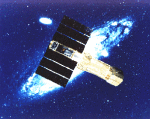 ASCA X-Ray Observatory
20.02.1996
Today marks the third anniversary of the launch of the Advanced Satellite for Cosmology and Astrophysics (ASCA; renamed from Astro D when launched). ASCA, seen here superposed on galaxy M31, is a Japanese satellite for which NASA has provided some scientific equipment. ASCA carries four large-area X-ray telescopes.
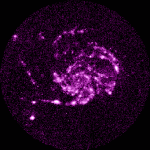 An Ultraviolet Image of M101
27.06.1995
This giant spiral galaxy, Messier 101 (M101), was photographed by the Ultraviolet Imaging Telescope onboard the Space Shuttle Endeavour during the Astro-2 mission (March 2 - 18, 1995). The image has been computer processed so that the colors represent the intensity of ultraviolet light.
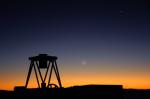 Hauoli Makahiki Hou
4.01.2006
Fading sunlight, a young crescent Moon, and brilliant Venus shared the western sky in this view of 2005's final sunset from the top of Mount Haleakala, on Maui, Hawaii. Also known as the Sacred House of the Sun, Haleakala, is Maui's dormant volcano.
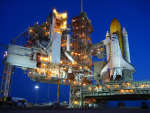 A Space Shuttle Before Dawn
13.05.2009
This shuttle has launched to space. Pictured above, the Space Shuttle Atlantis sat on Launch Pad 39A before dawn last month as it was prepared for the launch. The shuttle itself is visible on the image right, attached to a brown liquid fuel tank and two white solid rocket boosters.
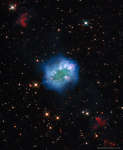 Jets from the Necklace Nebula
18.05.2021
What celestial body wears the Necklace Nebula? First, analyses indicate that the Necklace is a planetary nebula, a gas cloud emitted by a star toward the end of its life. Also, what appears to be diamonds in the Necklace are actually bright knots of glowing gas.
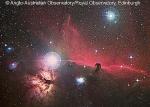 Orion's Horsehead Nebula
27.08.2000
The Horsehead Nebula is one of the most famous nebulae on the sky. It is visible as the black indentation to the red emission nebula seen just to the right of center of the above photograph. The bright star near the center is located in the belt of the familiar constellation of Orion.
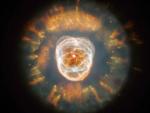 The Eskimo Nebula from Hubble
7.04.2002
In 1787, astronomer William Herschel discovered the Eskimo Nebula. From the ground, NGC 2392 resembles a person's head surrounded by a parka hood. In 2000, the Hubble Space Telescope imaged the Eskimo Nebula. From space, the nebula displays gas clouds so complex they are not fully understood.
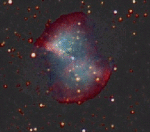 M27: The Dumbbell Nebula
29.07.1995
The Dumbbell Nebula is a beautiful red and blue planetary nebula in the constellation of Vulpecula. It is the 27th object on Charles Messier's list of diffuse sky objects, and so is referred to as M27. Its high surface brightness makes it a good target for small telescopes.
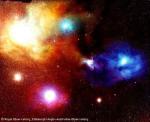 Antares and Rho Ophiuchi
9.05.2004
Why is the sky near Antares and Rho Ophiuchi so colorful? The colors result from a mixture of objects and processes. Fine dust illuminated from the front by starlight produces blue reflection nebulae. Gaseous clouds whose atoms are excited by ultraviolet starlight produce reddish emission nebulae. Backlit dust clouds block starlight and so appear dark.
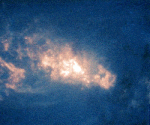 In the Center of Spiral M77
11.09.1996
What is happening in the center of nearby spiral galaxy M77? To find out, astronomers used the Hubble Space Telescope to peer deep into the dusty chaos of this active galactic nucleus in 1994.
|
January February March April May June July August September |
|||||||||||||||||||||||||||||||||||||||||||||||||