
|
You entered: meteor shower
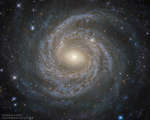 APOD: 2020 August 16 Б NGC 6814: Grand Design Spiral Galaxy from Hubble
15.08.2020
In the center of this serene stellar swirl is likely a harrowing black-hole beast. The surrounding swirl sweeps around billions of stars which are highlighted by the brightest and bluest. The breadth and beauty of the display give the swirl the designation of a grand design spiral galaxy.
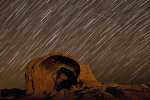 Quadrantids over Qumis
13.01.2011
The Quadrantid Meteor Shower is an annual event for planet Earth's northern hemisphere skygazers. It usually peaks briefly in the cold, early morning hours of January 4. The shower is named for its radiant point on the sky within the old, astronomically obsolete constellation Quadrans Muralis.
 APOD: 2025 September 16 Б New Comet SWAN25B over Mexico
15.09.2025
A newly discovered comet is already visible with binoculars. The comet, C/2025 R2 (SWAN) and nicknamed SWAN25B, is brightening significantly as it emerges from the Sun's direction and might soon become visible on your smartphone -- if not your eyes.
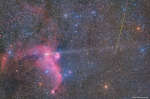 Meteor, Comet, and Seagull (Nebula)
20.10.2018
A meteor, a comet, and a photogenic nebula have all been captured in this single image. The closest and most fleeting is the streaking meteor on the upper right -- it was visible for less than a second.
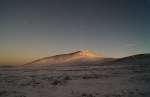 The Snows of Paranal
11.08.2011
Recorded last week, this dawn portrait of snowy mountain and starry sky captures a very rare scenario. The view does feature a pristine sky above the 2,600 meter high mountain Cerro Paranal, but clear skies over Paranal are not at all unusual.
 The Easterbunny Comes to NGC 4725
11.08.2016
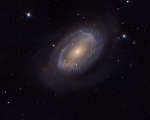
At first called "Easterbunny" by its discovery team, officially named Makemake is the second brightest dwarf planet of the Kuiper belt. The icy world appears twice in this astronomical image, based on data taken on June 29 and 30 of the bright spiral galaxy NGC 4725.
 Spiral Galaxy NGC 6744
9.08.2018
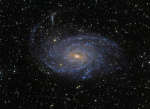
Beautiful spiral galaxy NGC 6744 is nearly 175,000 light-years across, larger than our own Milky Way. It lies some 30 million light-years distant in the southern constellation Pavo and appears as only a faint, extended object in small telescopes. We see the disk of the nearby island universe tilted towards our line of sight.
 Aurora Oklahoma
12.11.2003
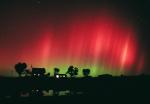
Nestled in the central US, the state of Oklahoma is noted for its gorgeous prairie skies and wide-open spaces, but not for frequent visitations of the northern lights. Still, following the intense solar activity...
 Halley s Nucleus: An Orbiting Iceberg
5.08.2000
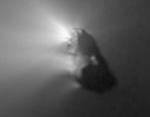
What does a comet nucleus look like? Formed from the primordial stuff of the solar system, it is thought to resemble a very dirty iceberg. But for active comets, telescopic images only reveal the surrounding cloud of gas and dust, the comet's coma, and the characteristic cometary tails.
 Comet Halley's Nucleus
9.12.1996
Here is what a comet nucleus really looks like. For all active comets except Halley, it was only possible to see the surrounding opaque gas cloud called the coma. During Comet Halley's most...
|
January February March April May June July August September October |
|||||||||||||||||||||||||||||||||||||||||||||||||