
|
You entered: galaxy formation
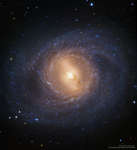 M95: Spiral Galaxy with an Inner Ring
29.05.2019
Why do some spiral galaxies have a ring around the center? First and foremost, M95 is one of the closer examples of a big and beautiful barred spiral galaxy. Visible in the featured combination...
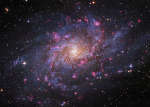 The Hydrogen Clouds of M33
3.10.2019
Gorgeous spiral galaxy M33 seems to have more than its fair share of glowing hydrogen gas. A prominent member of the local group of galaxies, M33 is also known as the Triangulum Galaxy and lies a mere 3 million light-years away.
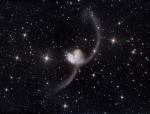 The Antennae
30.06.2006
Some 60 million light-years away in the southerly constellation Corvus, two large galaxies have collided. But stars in the two galaxies - NGC 4038 and NGC 4039 - don't collide in the course of the ponderous, billion year or so long event.
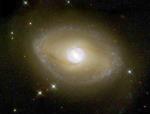 The Galactic Ring of NGC 6782
21.11.2001
Do spiral galaxies look the same in every color? NGC 6782 demonstrates colorfully that they do not. In visible light, NGC 6782 appears to be a normal spiral galaxy with a bright bar across its center.
 APOD: 2023 May 10 Б Milky Way over Egyptian Desert
10.05.2023
For ten years the stargazer dreamed of taking a picture like this. The dreamer knew that the White Desert National Park in Egypt's Western Desert is a picturesque place hosting numerous chalk formations sculpted into surreal structures by a sandy wind.
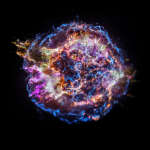 Recycling Cassiopeia A
28.12.2017
Massive stars in our Milky Way Galaxy live spectacular lives. Collapsing from vast cosmic clouds, their nuclear furnaces ignite and create heavy elements in their cores. After a few million years, the enriched material is blasted back into interstellar space where star formation can begin anew.
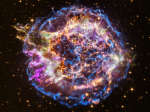 Recycling Cassiopeia A
6.09.2019
Massive stars in our Milky Way Galaxy live spectacular lives. Collapsing from vast cosmic clouds, their nuclear furnaces ignite and create heavy elements in their cores. After a few million years, the enriched material is blasted back into interstellar space where star formation can begin anew.
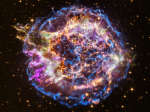 Recycling Cassiopeia A
23.01.2021
Massive stars in our Milky Way Galaxy live spectacular lives. Collapsing from vast cosmic clouds, their nuclear furnaces ignite and create heavy elements in their cores. After a few million years, the enriched material is blasted back into interstellar space where star formation can begin anew.
 Recycling Cassiopeia A
1.06.2023
Massive stars in our Milky Way Galaxy live spectacular lives. Collapsing from vast cosmic clouds, their nuclear furnaces ignite and create heavy elements in their cores. After a few million years, the enriched material is blasted back into interstellar space where star formation can begin anew.
 The Hydrogen Clouds of M33
30.09.2021
Gorgeous spiral galaxy M33 seems to have more than its fair share of glowing hydrogen gas. A prominent member of the local group of galaxies, M33 is also known as the Triangulum Galaxy and lies a mere 3 million light-years away.
|
January February March April May June July August |
||||||||||||||||||||||||||||||||||||||||||||||||||||||||