
|
You entered: dust cloud
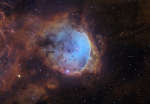 NGC 3324 in Carina
5.04.2018
This bright cosmic cloud was sculpted by stellar winds and radiation from the hot young stars of open cluster NGC 3324. With dust clouds in silhouette against its glowing atomic gas, the pocket-shaped star-forming region actually spans about 35 light-years. It lies some 7,500 light-years away toward the nebula rich southern constellation Carina.
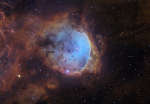 NGC 3324 in Carina
15.03.2019
This bright cosmic cloud was sculpted by stellar winds and radiation from the hot young stars of open cluster NGC 3324. With dust clouds in silhouette against its glowing atomic gas, the pocket-shaped star-forming region actually spans about 35 light-years. It lies some 7,500 light-years away toward the nebula rich southern constellation Carina.
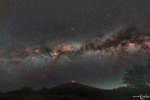 Mount Etna Milky Way
4.07.2024
A glow from the summit of Mount Etna, famous active stratovolcano of planet Earth, stands out along the horizon in this mountain and night skyscape. Bands of diffuse light from congeries of innumerable stars along the Milky Way galaxy stretch across the sky above.
 Eclipsed Moon in the Milky Way
17.06.2011
On June 15, the totally eclipsed Moon was very dark, with the Moon itself positioned on the sky toward the center of our Milky Way Galaxy. This simple panorama captures totality from northern Iran in 8 consecutive exposures each 40 seconds long.
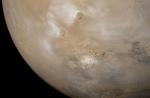 The Fogs of Mars
2.06.2003
Fogs of clouds and dust covered parts of southern Mars during last Martian winter. Giant volcanoes, such as Ascraeus Mons, the central circular feature near the top of the image, were surrounded by large water clouds. Slightly southwest, Pavonis Mons and Arisa Mons also peeked above their water clouds.
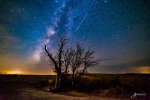 Comet Dust over Enchanted Rock
13.08.2015
Dusty debris from periodic Comet Swift-Tuttle was swept up by planet Earth this week. Vaporized by their passage through the dense atmosphere at 59 kilometers per second, the tiny grains produced a stream of Perseid meteors. A bright, colorful Perseid meteor flash was captured during this 20 second exposure.
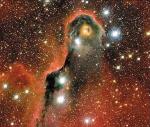 An Unusual Globule in IC 1396
24.03.2002
Is there a monster in IC 1396? Known to some as the Elephant's Trunk Nebula, parts of gas and dust clouds of this star formation region may appear to take on foreboding forms, some nearly human. The only real monster here, however, is a bright young star too far from Earth to hurt us.
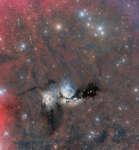 M78 Wide Field
20.01.2021
Interstellar dust clouds and glowing nebulae abound in the fertile constellation of Orion. One of the brightest, M78, is centered in this colorful, wide field view, covering an area north of Orion's belt. At a distance of about 1,500 light-years, the bluish reflection nebula is around 5 light-years across.
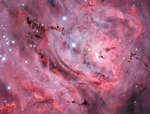 The Deep Lagoon
28.07.2015
Ridges of glowing interstellar gas and dark dust clouds inhabit the turbulent, cosmic depths of the Lagoon Nebula. Also known as M8, The bright star forming region is about 5,000 light-years distant.
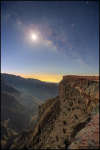 Milky Way in Moonlight
22.04.2016
A waning crescent moon, early morning twilight, and Al Hamra's city lights on the horizon can't hide the central Milky Way in this skyscape from planet Earth. Captured in a single exposure...
|
January February March April May June July August September |
|||||||||||||||||||||||||||||||||||||||||||||||||