
|
You entered: composite image
 Europa Rotating
16.01.2001
Evidence has been mounting that beneath the vast planes of ice that cover Europa lies water -- liquid oceans that might be home to alien life. The smallest of Jupiter's Galilean Moons (which include Io, Ganymede, and Callisto), Europa's deep interior is composed of mostly of silicate rock.
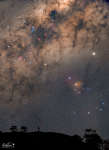 The Galaxy Above
15.10.2019
Have you contemplated your home galaxy lately? If your sky looked like this, perhaps you'd contemplate it more often! The featured picture is actually a composite of two images taken last month from the same location in south Brazil and with the same camera -- but a few hours apart.
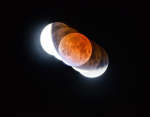 At the Shadow s Edge
25.11.2021
Shaped like a cone tapering into space, the Earth's dark central shadow or umbra has a circular cross-section. It's wider than the Moon at the distance of the Moon's orbit though. But during the lunar eclipse of November 18/19, part of the Moon remained just outside the umbral shadow.
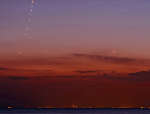 Venus, Mercury, and Moon
22.04.2010
Earlier this month, Venus and Mercury climbed into the western twilight, entertaining skygazers around planet Earth in a lovely conjunction of evening stars. Combining 8 images spanning April 4 through April 15, this composite tracks their progress through skies above Portsmouth, UK. Each individual image was captured at 19:50 UT.
 APOD: 2023 December 12 Б Aurora and Milky Way over Norway
12.12.2023
What are these two giant arches across the sky? Perhaps the more familiar one, on the left, is the central band of our Milky Way Galaxy. This grand disk of stars and nebulas here appears to encircle much of the southern sky.
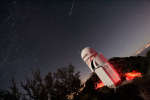 Geminids over Kit Peak
16.12.2010
Two large telescope domes stand in the foreground of this night sky view from Kitt Peak National Observatory, near Tucson, Arizona, USA. The dramatic scene was recorded early Tuesday morning, near the peak of December's Geminid Meteor Shower.
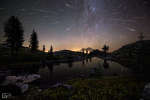 Perseid Meteors over Mount Shasta
8.08.2016
Where are all of these meteors coming from? In terms of direction on the sky, the pointed answer is the constellation of Perseus. That is why the meteor shower that peaks later this week is known as the Perseids -- the meteors all appear to came from a radiant toward Perseus.
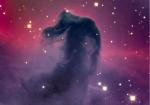 The Dark Horsehead Nebula
29.12.2000
While drifting through the cosmos, sculpted by stellar winds and radiation, this magnificent interstellar dust cloud has chanced to assume a recognizable shape. Fittingly named The Horsehead Nebula it is embedded in the immense complex of star forming gas and dust surrounding the Orion Nebula some 1,500 light-years distant.
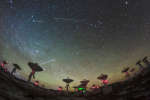 Quadrantids of the North
8.01.2022
Named for a forgotten constellation, the Quadrantid Meteor Shower puts on an annual show for planet Earth's northern hemisphere skygazers. The shower's radiant on the sky lies within the old, astronomically obsolete constellation Quadrans Muralis.
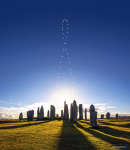 Equinox: Analemma over the Callanish Stones
23.09.2018
Does the Sun return to the same spot on the sky every day at the same time? No. A more visual answer to that question is an analemma, a composite image taken from the same spot at the same time over the course of a year.
|
January February March April May June July August September |
|||||||||||||||||||||||||||||||||||||||||||||||||