
|
You entered: blue moon
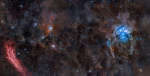 Seven Sisters Versus California
3.11.2009
On the upper right, dressed in blue, is the Pleiades. Also known as the Seven Sisters and M45, the Pleiades is one of the brightest and most easily visible open clusters on the sky. The Pleiades contains over 3,000 stars, is about 400 light years away, and only 13 light years across.
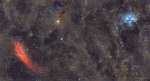 Seven Sisters versus California
5.04.2022
On the upper right, dressed in blue, is the Pleiades. Also known as the Seven Sisters and M45, the Pleiades is one of the brightest and most easily visible open clusters on the sky. The Pleiades contains over 3,000 stars, is about 400 light years away, and only 13 light years across.
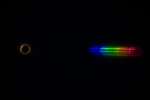 The Flash Spectrum of the Sun
15.11.2013
In a flash, the visible spectrum of the Sun changed from absorption to emission on November 3rd, during the brief total phase of a solar eclipse. That fleeting moment is captured by telephoto lens and diffraction grating in this well-timed image from clearing skies over Gabon in equatorial Africa.
 APOD: 2024 March 18 Б Comet Pons Brooks Swirling Coma
18.03.2024
A bright comet will be visible during next month's total solar eclipse. This very unusual coincidence occurs because Comet 12P/Pons-Brooks's return to the inner Solar System places it by chance only 25 degrees away from the Sun during Earth's April 8 total solar eclipse.
 APOD: 2025 April 8 Б Moon Visits Sister Stars
8.04.2025
Sometimes, the Moon visits the Pleiades. Technically, this means that the orbit of our Moon takes it directly in front of the famous Pleiades star cluster, which is far in the distance. The technical...
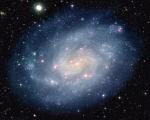 Spiral Galaxy NGC 300
21.08.2002
NGC 300 is so interesting because it is so normal. An Sc-type spiral galaxy in the nearby Sculptor group of galaxies, NGC 300 shows typical flowing blue spiral arms, an expected compact nucleus, and the requisite amount of stars, star clusters, and nebulae.
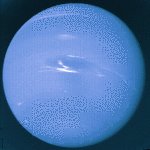 Neptune: Big Blue Giant
17.08.1995
This picture was taken by the Voyager 2 spacecraft in 1986 - the only spacecraft ever to visit Neptune. Neptune will be the farthest planet from the Sun until 1999, when the elliptical orbit of Pluto will cause it to once again resume this status.
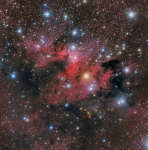 The Light, the Dark, and the Dusty
5.03.2020
This colorful skyscape spans about four full moons across nebula rich starfields along the plane of our Milky Way Galaxy in the royal northern constellation Cepheus. Near the edge of the region's massive...
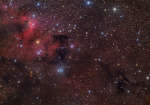 The Light, the Dark, and the Dusty
11.06.2015
This colorful skyscape spans about three full moons (1.5 degrees) across nebula rich starfields along the plane of our Milky Way Galaxy in the royal northern constellation Cepheus. Near the edge of the region...
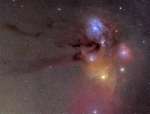 The Dark River to Antares
8.07.2009
Connecting the Pipe Nebula to the colorful regon near bright star Antares is a dark cloud dubbed the Dark River, flowing from the picture's left edge. Murky looking, the Dark River's appearance is caused by dust obscuring background starlight, although the dark nebula contains mostly hydrogen and molecular gas.
|
January February March April May June July August |
||||||||||||||||||||||||||||||||||||||||||||||||||||||||