
|
You entered: star
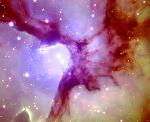 In the Center of the Trifid Nebula
26.06.2002
Clouds of glowing gas mingle with lanes of dark dust in the Trifid Nebula, a star forming region toward the constellation of Sagittarius. In the center, the three huge dark dust lanes that give the Trifid its name all come together.
 Sagittarius and the Central Milky Way
5.06.1996
What does the center of our Milky Way Galaxy look like? No one knows! It is not possible to see the Galactic center in light our eyes are sensitive to because the thick dust in the plane of our Galaxy obscures it.
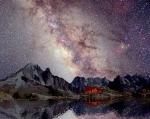 The Milky Way Over Mount Blanc
23.09.2002
Have you ever seen the band of our Milky Way Galaxy? Chances are you have never seen it like this -- nor could you. In a clear sky from a dark location at the right time, a faint band of light is visible across the sky. This band is the disk of our spiral galaxy.
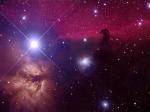 Orions Horsehead Nebula
29.01.2003
The Horsehead Nebula is one of the most famous nebulae on the sky. It is visible as the dark indentation to the red emission nebula seen above and to the right of center in the above photograph. The bright star on the left is located in the belt of the familiar constellation of Orion.
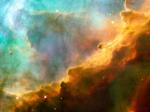 APOD: 2004 August 28- M17: A Hubble Close-Up
28.08.2004
Sculpted by stellar winds and radiation, these fantastic, undulating shapes lie within the stellar nursery known as M17, the Omega Nebula, some 5,500 light-years away in the nebula-rich constellation Sagittarius. The lumpy features...
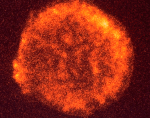 Tychos Supernova Remnant in X ray
7.03.1999
How often do stars explode? By looking at external galaxies, astronomers can guess that these events, known as a supernovae, should occur about once every 30 years in a typical spiral galaxy like our MilkyWay.
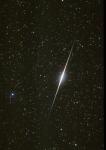 Iridium 52: Not A Meteor
22.10.1999
While hunting for meteors in the night sky above the White Mountains near Bishop, California, astrophotographer James Young instead captured this brilliant celestial apparition. Recorded near twilight on August 13, the bright streak is not the flash of a meteor trail but sunlight glinting from a satellite.
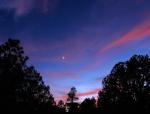 Red, White, and Blue Sky
4.07.2007
Contrasting colors in this beautiful sunset sky were captured on June 30 from Clear Creek Canyon Observatory in central Arizona, USA. The twilight scene includes brilliant Venus as the evening star, with a bright Saturn just above it, shining through thin clouds.
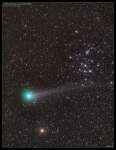 Comet Lovejoy with M44
9.11.2013
While anxiously waiting for Comet ISON to brighten further as it falls toward the Sun, northern skygazers can also find three other bright comets in the east before dawn. In fact, Comet Lovejoy C/2013 R1 is currently the morning sky's brightest.
 Messier 87
20.02.2025
Enormous elliptical galaxy Messier 87 is about 50 million light-years away. Also known as NGC 4486, the giant galaxy holds trillions of stars compared to the mere billions of stars in our large spiral Milky Way. M87 reigns as the large central elliptical galaxy in the Virgo galaxy cluster.
|
January February March April May June July August September |
|||||||||||||||||||||||||||||||||||||||||||||||||