
|
You entered: planets
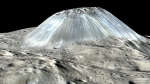 Unusual Mountain Ahuna Mons on Asteroid Ceres
16.06.2019
What created this unusual mountain? There is a new theory. Ahuna Mons is the largest mountain on the largest known asteroid in our Solar System, Ceres, which orbits our Sun in the main asteroid belt between Mars and Jupiter. Ahuna Mons, though, is like nothing that humanity has ever seen before.
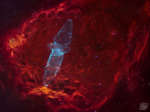 Ou4: A Giant Squid in a Flying Bat
7.10.2020
A very faint but very large squid-like nebula is visible in planet Earth's sky -- but inside a still larger bat. The Giant Squid Nebula cataloged as Ou4, and Sh2-129 also known as the Flying Bat Nebula, are both caught in this cosmic scene toward the royal royal constellation Cepheus.
 M51 in 255 Hours
11.08.2023
An intriguing pair of interacting galaxies, M51 is the 51st entry in Charles Messier's famous catalog. Perhaps the original spiral nebula, the large galaxy with whirlpool-like spiral structure seen nearly face-on is also cataloged as NGC 5194. Its spiral arms and dust lanes sweep in front of a companion galaxy (right), NGC 5195.
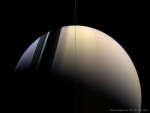 Saturn in Blue and Gold
29.08.2017
Why is Saturn partly blue? The featured picture of Saturn approximates what a human would see if hovering close to the giant ringed world. The image was taken in 2006 March by the robot Cassini spacecraft now orbiting Saturn. Here Saturn's majestic rings appear directly only as a thin vertical line.
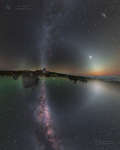 Two Hemisphere Night Sky
27.02.2020
The Sun is hidden by a horizon that runs across the middle in this two hemisphere view of Earth's night sky. The digitally stitched mosaics were recorded from corresponding latitudes, one 29 degrees north and one 29 degrees south of the planet's equator.
 Island Universe, Cosmic Sand
14.08.2021
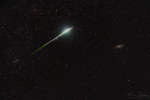
Stars in our own Milky Way Galaxy are scattered through this eye-catching field of view. From the early hours after midnight on August 13, the 30 second exposure of the night sky over Busko-Zdroj, Poland records the colorful and bright trail of a Perseid meteor.
 Man Enters Space
12.04.1996
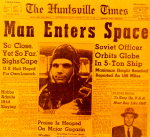
Thirty five years ago today, Soviet cosmonaut Yuri Alexseyevich Gagarin became the first human in space. On April 12, 1961, his remotely controlled Vostok 1 spacecraft lofted him to an altitude of 200 miles and carried him once around planet Earth.
 A Dark Sky Over Sequoia National Park
27.08.2009
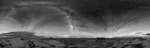
Scroll right to take in the view from the highest summit in the contiguous USA. The above 360-degree digitally stitched panorama, taken in mid-July, shows the view from 4,400-meter high Mt. Whitney in Sequoia National Park, California. In the foreground, angular boulders populate Mt.
 InSights First Image from Mars
27.11.2018
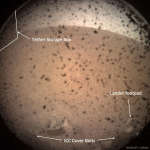
Welcome to Mars, NASA Insight. Yesterday NASA's robotic spacecraft InSight made a dramatic landing on Mars after a six-month trek across the inner Solar System. Needing to brake from...
 Looking Sideways from the Parker Solar Probe
9.12.2019
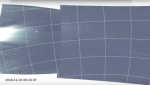
Everybody sees the Sun. Nobody's been there. Starting in 2018 though, NASA launched the robotic Parker Solar Probe (PSP) to investigate regions near to the Sun for the first time. The PSP's looping orbit brings it yet closer to the Sun each time around -- every few months.
|
January February March April May June July August September |
|||||||||||||||||||||||||||||||||||||||||||||||||