
|
You entered: Earth
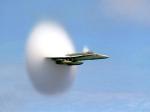 A Sonic Boom
19.08.2007
Is this what a sonic boom looks like? When an airplane travels at a speed faster than sound, density waves of sound emitted by the plane cannot precede the plane, and so accumulate in a cone behind the plane.
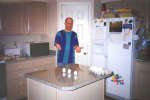 Egging On the Autumnal Equinox
21.09.2008
Tomorrow is the autumnal equinox -- should eggs be able to stand on end? This long-standing myth loses much of its mystique after a demonstration that eggs can be made to stand on end during any day of the year. Pictured above, Dr.
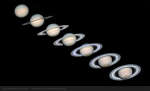 6 Years of Saturn
4.09.2009
Today, planet Earth passes through the plane of Saturn's rings. From the perspective of earthbound astronomers, Saturn's rings will be edge-on. The problem is, Saturn itself is now very close to the Sun, low on horizon after sunset, so good telescopic images will be difficult to come by.
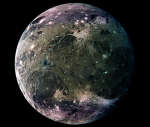 Ganymede Enhanced
20.09.2009
What does the largest moon in the Solar System look like? Ganymede, larger than even Mercury and Pluto, has a surface speckled with bright young craters overlying a mixture of older, darker, more cratered terrain laced with grooves and ridges.
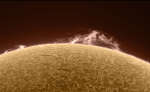 Reinvigorated Sun and Prominence
23.03.2010
Dramatic prominences can sometimes be seen looming just beyond the edge of the sun. Such was the case last week as a giant prominence, visible above on the right, highlighted a Sun showing increased activity as it comes off an unusually quiet Solar Minimum.
 SDO: The Extreme Ultraviolet Sun
23.04.2010
Don't panic, the Sun has not gone wild. But this wild-looking portrait of the nearest star to planet Earth was made on March 30th by the recently launched Solar Dynamics Observatory (SDO). Shown in false-color, the composite view covers extreme ultraviolet wavelengths and traces hot plasma at temperatures approaching 1 million kelvins.
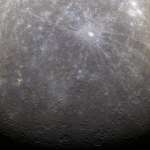 MESSENGER at Mercury
31.03.2011
On March 17, the MESSENGER spacecraft became the first to orbit Mercury, the solar system's innermost planet. This is its first processed color image since entering Mercury orbit. Larger, denser, and with almost twice the surface gravity of Earth's moon, Mercury still looks moon-like at first glance.
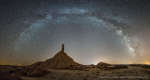 Milky Way Over Spains Bardenas Reales
2.09.2013
What's that below the Milky Way? First, across the top of the above image, lies the faint band that is our planet's sideways view of the central disk of our home Milky Way Galaxy.
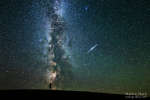 The Flare and the Galaxy
2.09.2015
Is this person throwing a lightning bolt? No. Despite appearances, this person is actually pointing in the direction of a bright Iridium flare, a momentary reflection of sunlight off of a communications satellite in orbit around the Earth.
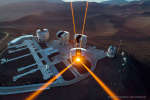 Attack of the Laser Guide Stars
18.05.2018
Dodging powerful laser beams, a drone captured this stunning aerial view. The confrontation took place above the 8.2 meter diameter Very Large Telescopes of the Paranal Observatory on planet Earth. Firing during a test...
|
January February March April May June July August September October |
|||||||||||||||||||||||||||||||||||||||||||||||||