
|
You entered: nearest stars
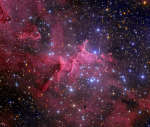 Melotte 15 in the Heart
27.12.2013
Cosmic clouds seem to form fantastic shapes in the central regions of emission nebula IC 1805. Of course, the clouds are sculpted by stellar winds and radiation from massive hot stars in the nebula's newborn star cluster, Melotte 15.
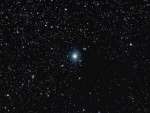 The Mystery of the Fading Star
7.01.2010
Every 27 years Epsilon Aurigae fades, remaining dim for roughly two years before growing bright again. Since the 19th century, astronomers have studied the mystery star, eventually arguing that Epsilon Aur, centered in this telescopic skyview, was actually undergoing a long eclipse by a dark companion object.
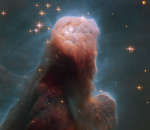 The Cone Nebula from Hubble
28.05.2014
Stars are forming in the gigantic dust pillar called the Cone Nebula. Cones, pillars, and majestic flowing shapes abound in stellar nurseries where natal clouds of gas and dust are buffeted by energetic winds from newborn stars. The Cone Nebula, a well-known example, lies within the bright galactic star-forming region NGC 2264.
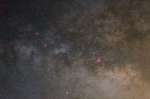 Messier s Eleven
12.07.2013
This fifteen degree wide field of view stretches across the crowded starfields of Sagittarius toward the center of our Milky Way galaxy. In fact, the center of the galaxy lies near the right edge of the rich starscape and eleven bright star clusters and nebulae fall near the center of the frame.
 Dark Markings of the Sky
25.04.2009
Based on wide field photographs, American astronomer Edward Emerson Barnard cataloged the dark markings of the sky in the early 20th century. Barnard's markings are dark nebulae, interstellar clouds of obscuring gas and dust.
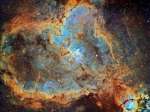 IC 1805: The Heart Nebula
4.03.2013
Sprawling across almost 200 light-years, emission nebula IC 1805 is a mix of glowing interstellar gas and dark dust clouds. Derived from its Valentine's-Day-approved shape, its nickname is the Heart Nebula. About 7,500 light-years away in the Perseus spiral arm of our galaxy, stars were born in IC 1805.
 Classic Orion Nebulae
26.08.2009
The Great Nebula in Orion, also known as M42, is one of the most famous nebulae in the sky. The star forming region's glowing gas clouds and hot young stars are near...
 Comet Machholz in View
4.01.2005
Good views of Comet Machholz are in store for northern hemisphere comet watchers in January. Now making its closest approach to planet Earth, the comet will pass near the lovely Pleiades star cluster on January 7th and the double star cluster in Perseus on January 27th as Machholz moves relatively quickly through the evening sky.
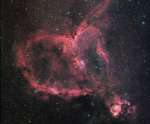 IC 1805: The Heart Nebula
13.02.2009
Sprawling across almost 200 light-years, emission nebula IC 1805 is a mix of glowing interstellar gas and dark dust clouds. Derived from its Valentine's-Day-approved shape, its nickname is the Heart Nebula. About 7,500 light-years away in the Perseus spiral arm of our galaxy, stars were born in IC 1805.
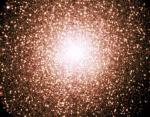 Globular Cluster 47 Tucanae from SALT
5.09.2005
Stars come in bunches. Of the over 200 globular star clusters that orbit the center of our Milky Way Galaxy, 47 Tucanae is the second brightest globular cluster, behind Omega Centauri. Known to some affectionately as 47 Tuc or NGC 104, it is only visible from Earth's Southern Hemisphere.
|
January February March April May June July August September October |
|||||||||||||||||||||||||||||||||||||||||||||||||