
|
You entered: Mercury
 Solar System Family Portrait
13.07.2024
In 1990, cruising four billion miles from the Sun, the Voyager 1 spacecraft looked back to make this first ever Solar System family portrait. The complete portrait is a 60 frame mosaic made from a vantage point 32 degrees above the ecliptic plane.
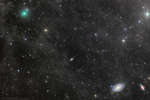 Comet ATLAS and the Mighty Galaxies
21.03.2020
Comet ATLAS C/2019 Y4 was discovered by the NASA funded Asteroid Terrestrial-impact Last Alert System, the last comet discovery reported in 2019. Now growing brighter in northern night skies, the comet's pretty greenish...
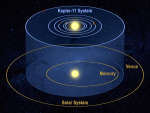 Six Worlds for Kepler 11
3.02.2011
Six worlds orbit Kepler-11, a sunlike star 2,000 light-years distant in the constellation Cygnus. The new discovery, based on data from NASA's planet hunting Kepler spacecraft, makes the Kepler-11 system the fullest exoplanetary system known.
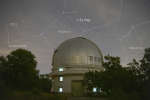 50 Light years to 51 Pegasi
9.10.2021
It's only 50 light-years to 51 Pegasi. That star's position is indicated in this snapshot from August, taken on a hazy night with mostly brighter stars visible above the dome at Observatoire de Haute-Provence in France.
 APOD: 2024 February 19 Б Looking Sideways from the Parker Solar Probe
19.02.2024
What's happening near the Sun? To help find out, NASA launched the robotic Parker Solar Probe (PSP) to investigate regions closer to the Sun than ever before. The PSP's looping orbit brings it nearer to the Sun each time around -- every few months.
 Temperatures on Exoplanet WASP 43b
3.05.2024
A mere 280 light-years from Earth, tidally locked, Jupiter-sized exoplanet WASP-43b orbits its parent star once every 0.8 Earth days. That puts it about 2 million kilometers (less than 1/25th the orbital distance of Mercury) from a small, cool sun.
 Phaethon s Brood
12.12.2024
Based on its well-measured orbit, 3200 Phaethon (sounds like FAY-eh-thon) is recognized as the source of the meteoroid stream responsible for the annual Geminid meteor shower. Even though most meteor shower parents are comets, 3200 Phaethon is a known and closely tracked near-Earth asteroid with a 1.4 year orbital period.
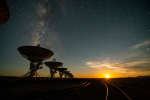 The Very Large Array at Moonset
9.10.2020
An inspirational sight, these giant dish antennas of the Karl G. Jansky Very Large Array (VLA) rise above the New Mexico desert at moonset. Mounted on piers but transportable on railroad tracks to change...
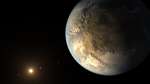 Earth size Kepler 186f
19.04.2014
Planet Kepler-186f is the first known Earth-size planet to lie within the habitable zone of a star beyond the Sun. Discovered using data from the prolific planet-hunting Kepler spacecraft, the distant world orbits...
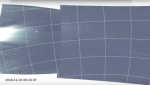 Looking Sideways from the Parker Solar Probe
9.12.2019
Everybody sees the Sun. Nobody's been there. Starting in 2018 though, NASA launched the robotic Parker Solar Probe (PSP) to investigate regions near to the Sun for the first time. The PSP's looping orbit brings it yet closer to the Sun each time around -- every few months.
|
January February March April May June July August September October |
|||||||||||||||||||||||||||||||||||||||||||||||||