
|
You entered: HST
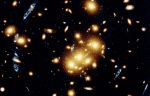 Giant Cluster Bends, Breaks Galaxy Images
24.04.1996
What are those strange blue objects? Many are images of a single, unusual, beaded, blue, ring-like galaxy which just happens to line-up behind a giant cluster of galaxies. Cluster galaxies here appear yellow and -- together with the cluster's dark matter -- act as a gravitational lens.
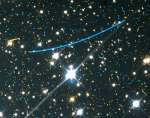 Asteroids in the Distance
10.02.2013
Rocks from space hit Earth every day. The larger the rock, though, the less often Earth is struck. Many kilograms of space dust pitter to Earth daily. Larger bits appear initially as a bright meteor. Baseball-sized rocks and ice-balls streak through our atmosphere daily, most evaporating quickly to nothing.
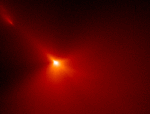 Near the Nucleus of Hyakutake
28.03.1996
NASA's Hubble Space Telescope captured this image of the near-nuclear region of Comet Hyakutake on March 25 as the comet approached within 9.3 million miles of the Earth. It covers a relatively "small" 2,000 mile wide area with the sunward direction toward the lower right (tailward is upper left).
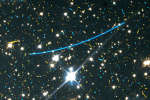 Asteroids in the Distance
6.03.2011
Rocks from space hit Earth every day. The larger the rock, though, the less often Earth is struck. Many kilograms of space dust pitter to Earth daily. Larger bits appear initially as a bright meteor. Baseball-sized rocks and ice-balls streak through our atmosphere daily, most evaporating quickly to nothing.
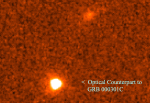 A GRB 000301C Symphony
14.03.2000
Telescopic instruments in Earth and space are still tracking a tremendous explosion that occurred across the universe. A nearly unprecedented symphony of international observations began abruptly on March 1 when Earth-orbiting RXTE, Sun-orbiting Ulysses, and asteroid-orbiting NEAR all detected a 10-second burst of high-frequency gamma radiation.
|
January February March April May June July August September |
|||||||||||||||||||||||||||||||||||||||||||||||||