
|
You entered: clouds
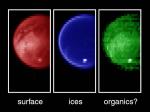 Titan from Cassini in Infrared
6.07.2004
Could life exist under the smog of Titan? If not, what is creating all of the methane? To help answer these questions, the largest and most mysterious moon of Saturn got a quick first look from the Cassini robot spacecraft soon after entering orbit around the giant planet last week.
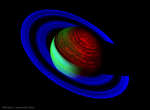 Neon Saturn
12.03.2016
If seen in the right light, Saturn glows like a neon sign. Although Saturn has comparatively little of the element neon, a composite image false-colored in three bands of infrared light highlights features of the giant ringed planet like a glowing sign.
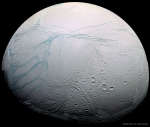 Fresh Tiger Stripes on Saturns Enceladus
26.04.2020
How will humanity first learn of extraterrestrial life? One possibility is to find it under the icy surface of Saturn's moon Enceladus. A reason to think that life may exist there are long features -- dubbed tiger stripes -- that are known to be spewing ice from the moon's icy interior into space.
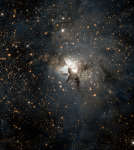 Central Lagoon in Infrared
18.03.2021
Stars fill this infrared view, spanning 4 light-years across the center of the Lagoon Nebula. Visible light images show the glowing gas and obscuring dust clouds that dominate the scene. But this infrared image...
 APOD: 2023 September 10 Б An Annular Solar Eclipse over New Mexico
9.09.2023
What is this person doing? In 2012, an annular eclipse of the Sun was visible over a narrow path that crossed the northern Pacific Ocean and several western US states. In an annular solar...
 Satellites Collide in Low Earth Orbit
17.02.2009
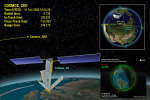
How often do satellites collide? Although minuscule space debris may strike any satellite on occasion, the first known collision between time two full satellites occurred only last week. Even though thousands of satellites have been launched, the low collision rate is caused by the great vastness of space.
 Hanny s Voorwerp
9.02.2011
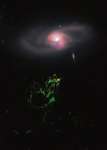
Hanny's Voorwerp, Dutch for "Hanny's Object", is enormous, about the size of our own Milky Way Galaxy. Glowing strongly in the greenish light produced by ionized oxygen atoms, the mysterious voorwerp is below spiral galaxy IC 2497 in this view from the Hubble Space Telescope.
 W5: Pillars of Star Formation
20.11.2011
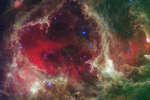
How do stars form? A study of star forming region W5 by the sun-orbiting Spitzer Space Telescope provides clear clues by recording that massive stars near the center of empty cavities are older than stars near the edges.
 M51 in 255 Hours
10.08.2023
An intriguing pair of interacting galaxies, M51 is the 51st entry in Charles Messier's famous catalog. Perhaps the original spiral nebula, the large galaxy with whirlpool-like spiral structure seen nearly face-on is also cataloged as NGC 5194. Its spiral arms and dust lanes sweep in front of a companion galaxy (right), NGC 5195.
 LL Ori and the Orion Nebula
19.01.2006
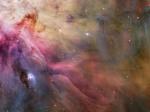
This esthetic close-up of cosmic clouds and stellar winds features LL Orionis, interacting with the Orion Nebula flow. Adrift in Orion's stellar nursery and still in its formative years, variable star LL Orionis produces a wind more energetic than the wind from our own middle-aged Sun.
|
January February March April May June July August September |
|||||||||||||||||||||||||||||||||||||||||||||||||