
|
You entered: Sun
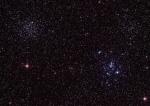 Stars Young and Old
4.08.2005
Galactic or open star clusters are relatively young swarms of bright stars born together near the plane of our Milky Way Galaxy. Separated by about a degree on the sky, two nice examples...
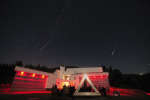 Meteors Over Quebec
16.08.2010
Meteors streaked through the sky above many of Earth's cities last week, but nobody was hurt, and no damage has been reported. The assault from space appeared to originate from someplace in the constellation of Perseus, and included millions of small projectiles hurtling toward Earth at over 200,000 kilometers per hour.
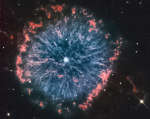 NGC 6751: The Glowing Eye Nebula
13.03.2013
Planetary nebulae can look simple, round, and planet-like in small telescopes. But images from the orbiting Hubble Space Telescope have become well known for showing these fluorescent gas shrouds of dying Sun-like stars to possess a staggering variety of detailed symmetries and shapes.
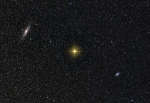 M31 versus M33
26.09.2015
Separated by about 14 degrees (28 Full Moons) in planet Earth's sky, spiral galaxies M31 at left, and M33 are both large members of the Local Group, along with our own Milky Way galaxy.
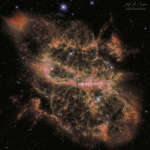 APOD: 2020 August 14 Б NGC 5189: An Unusually Complex Planetary Nebula
14.08.2020
Why is this nebula so complex? When a star like our Sun is dying, it will cast off its outer layers, usually into a simple overall shape. Sometimes this shape is a sphere, sometimes a double lobe, and sometimes a ring or a helix.
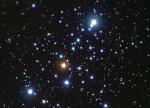 Distant Open Cluster M103
7.02.2001
Bright blue stars highlight the open cluster known as M103. The gas clouds from which these stars condensed has long dispersed. Of the stars that were formed, the brightest, bluest, and most massive have already used up their nuclear fuel and self-destructed in supernova explosions.
 Comet 57P Falls to Pieces
2.08.2002
Comet 57P has fallen to pieces, at least 19 of them. Orbiting the Sun every 5.9 years or so this faint comet - also christened Comet 57P/du Toit-Neujmin-Delporte for its three 1941 co-discoverers - is simply...
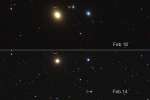 Vesta Near Opposition
18.02.2010
Main belt asteroid 4 Vesta is at its brightest now. The small world is near opposition (opposite the Sun in the sky) and closest to Earth. But even at its brightest, Vesta is just too faint to spot with the naked-eye.
 Opportunity at Santa Maria Crater
29.01.2011
Celebrating 7 years on the surface of the Red Planet, Mars exploration rover Opportunity now stands near the rim of 90 meter wide Santa Maria crater. Remarkably, Opportunity and its fellow rover Spirit were initially intended for a 3 month long primary mission.
 Airglow, Gegenschein, and Milky Way
20.04.2013
As far as the eye could see, it was a dark night at Las Campanas Observatory in the southern Atacama desert of Chile. But near local midnight on April 11, this mosaic of 3 minute long exposures revealed a green, unusually intense, atmospheric airglow stretching over thin clouds.
|
January February March April May June July August September |
|||||||||||||||||||||||||||||||||||||||||||||||||