
|
You entered: nearest stars
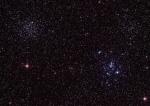 Stars Young and Old
4.08.2005
Galactic or open star clusters are relatively young swarms of bright stars born together near the plane of our Milky Way Galaxy. Separated by about a degree on the sky, two nice examples...
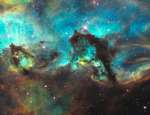 The Seahorse of the Large Magellanic Cloud
29.11.2014
It may look like a grazing seahorse, but the dark object toward the image right is actually a pillar of smoky dust about 20 light years long. The curiously-shaped dust structure occurs in our neighboring Large Magellanic Cloud, in a star forming region very near the expansive Tarantula Nebula.
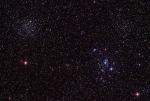 Star Clusters Young and Old
10.09.2006
Many stars form in clusters. Galactic or open star clusters are relatively young swarms of bright stars born together near the plane of our Milky Way Galaxy. Separated by about a degree...
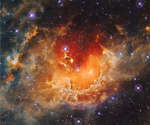 Star Formation in the Tadpole Nebula
17.11.2014
Dusty emission in the Tadpole nebula, IC 410, lies about 12,000 light-years away in the northern constellation Auriga. The cloud of glowing gas is over 100 light-years across, sculpted by stellar winds and radiation from embedded open star cluster NGC 1893.
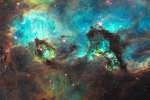 The Seahorse of the Large Magellanic Cloud
23.03.2009
To some it may look to some like a big space monster, but it is more big than monster. To others it may look like a grazing seahorse, but the dark object toward the image right is actually an inanimate pillar of smoky dust about 20 light years long.
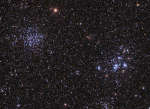 M46 and M47: Star Clusters Young and Old
3.04.2012
Many stars form in clusters. Galactic or open star clusters are relatively young swarms of bright stars born together near the plane of our Milky Way Galaxy. Separated by about a degree...
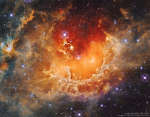 Star Formation in the Tadpole Nebula
28.01.2020
What's all of the commotion in the Tadpole Nebula? Star formation. Dusty emission in the Tadpole Nebula, IC 410, lies about 12,000 light-years away in the northern constellation of the Charioteer (Auriga).
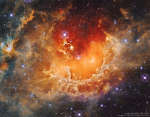 Star Formation in the Tadpole Nebula
7.05.2017
What's all of the commotion in the Tadpole nebula? Star formation. Dusty emission in the Tadpole nebula, IC 410, lies about 12,000 light-years away in the northern constellation of the Charioteer (Auriga).
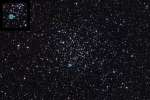 Stars Young and Old
26.03.2009
Galactic or open star clusters are relatively young. These swarms of stars are born near the plane of the Milky Way, but their numbers steadily dwindle as cluster members are strewn through the Galaxy by gravitational interactions.
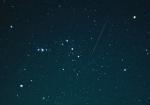 A 2000 Leonid Through Orion
20.11.2000
The Leonid Meteor Shower this year could be described as good but not great. During November 17 and 18 the Earth crossed through several streams of sand-sized grit left orbiting the Sun by Comet Tempel-Tuttle. Several distinct peaks in meteor activity were reported, with
|
January February March April May June July August September October |
|||||||||||||||||||||||||||||||||||||||||||||||||