
|
You entered: map
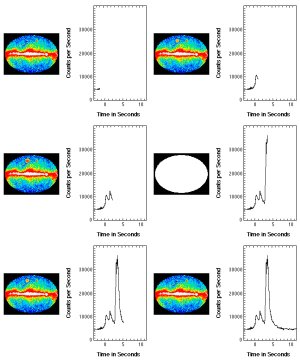 Gamma Ray Bursting
3.11.1999
Using graphics and data from NASA's Compton Gamma Ray Observatory, this animation illustrates one of the most exciting mysteries of modern astrophysics, gamma-ray bursts. Incredibly gamma-ray bursts, sudden flashes of radiation with over 100,000 times the energy of visible light photons, occur several times a day.
 Dark Matter Movie from the Bolshoi Simulation
3.10.2011
What if you could fly through the universe and see dark matter? While the technology for taking such a flight remains under development, the technology for visualizing such a flight has taken a grand leap forward with the completion of the Bolshoi Cosmological Simulation.
 The El Gordo Massive Galaxy Cluster
22.04.2014
It is bigger than a bread box. In fact, it is much bigger than all bread boxes put together. Galaxy cluster ACT-CL J0102-4915 is one of the largest and most massive objects known. Dubbed...
 Descending Toward Asteroid Bennu
11.10.2020
What would it be like to land on an asteroid? Although no human has yet done it, NASA's robotic OSIRIS-REx spacecraft is scheduled to attempt to touch the surface of asteroid 101955 Bennu next week.
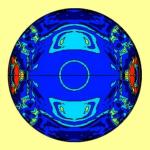 Solar Neutrino Astronomy
17.05.2001
Neutrinos are subatomic particles generated by the nuclear reactions which power stars like our Sun. Flying outward from the Sun's core, they easily pass through the Sun (and almost anything else!) unimpeded and should be detectable by earth-based neutrino "telescopes".
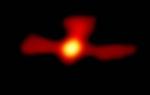 A Galactic Cloud of Antimatter
1.05.1997
The center of our Milky Way Galaxy is full of surprises. Its latest spectacular is a mysterious cloud glowing in gamma rays produced by annihilating antimatter particles! Star Trek fans are all too familiar...
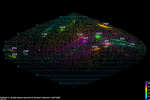 Forty Thousand Meteor Origins Across the Sky
11.05.2009
Where do meteors come from? Visible meteors are typically sand-sized grains of ice and rock that once fragmented from comets. Many a meteor shower has been associated with a known comet, although some intriguing orphan showers do remain.
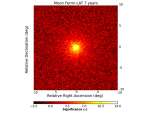 Fermi s Gamma-ray Moon
28.04.2016
If you could only see gamma-rays, photons with up to a billion or more times the energy of visible light, the Moon would be brighter than the Sun! That startling notion underlies this novel...
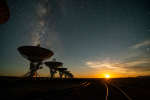 The Very Large Array at Moonset
8.10.2020
An inspirational sight, these giant dish antennas of the Karl G. Jansky Very Large Array (VLA) rise above the New Mexico desert at moonset. Mounted on piers but transportable on railroad tracks to change...
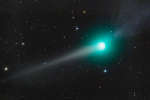 Two Tails of Comet Lulin
24.02.2009
Go outside tonight and see Comet Lulin. From a dark location, you should need only a good star map and admirable perseverance -- although wide-field binoculars might help. Yesterday, Comet Lulin passed its closest to Earth, so that the comet will remain near its brightest over the next few days.
|
January February March April May June July August September October November |
||||||||||||||||||||||||||||||||||||||||||||||||||||||||