
|
You entered: gas
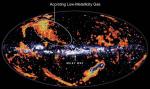 High Velocity Clouds and the Milky Way
14.12.1999
Where are these gas clouds going so quickly? High velocity clouds (HVCs) of gas have been seen for decades but their origins and destinations have remained mysterious. Recent measurements have now placed at least...
 In the Center of the Dumbbell Nebula
13.10.1998
Here's part of the Dumbbell Nebula that you can't see through binoculars. To see this, we suggest a sophisticated spectrograph attached to a telescope with an 8-meter aperture. Pictured above is the central part of the Dumbbell Nebula, also known as M27 and NGC 6853.
 Nebula Nova Cygni Turns On
16.01.2005
Old photographs show no evidence of the above nebula. In 1992, a white dwarf star toward the constellation of Cygnus blew off its outer layers in a classical nova explosion: an event called Nova Cygni 1992.
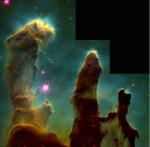 Stars from Eagles Eggs
2.05.1999
Newborn stars are forming in the Eagle Nebula. This image, taken with the Hubble Space Telescope in 1995, shows evaporating gaseous globules (EGGs) emerging from pillars of molecular hydrogen gas and dust. The giant pillars are light years in length and are so dense that interior gas contracts gravitationally to form stars.
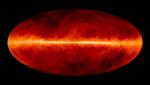 A Sky Full Of Hydrogen
13.01.2001
Interstellar space is filled with extremely tenuous clouds of gas which are mostly Hydrogen. The neutral hydrogen atom (HI in astronomer's shorthand) consists of 1 proton and 1 electron. The proton and electron spin like tops but can have only two orientations; spin axes parallel or anti-parallel.
 M42: Inside the Orion Nebula
8.04.2014
The Great Nebula in Orion, an immense, nearby starbirth region, is probably the most famous of all astronomical nebulas. Here, glowing gas surrounds hot young stars at the edge of an immense interstellar molecular cloud only 1500 light-years away.
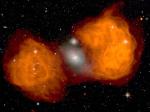 The Giant Radio Lobes of Fornax A
28.06.2005
Together, the radio lobes span over one million light years -- what caused them? In the center is a large but peculiar elliptical galaxy dubbed NGC 1316. Detailed inspection of the NGC 1316 system indicates that it began absorbing a small neighboring galaxy about 100 million years ago.
 In the Center of the Omega Nebula
6.05.2012
In the depths of the dark clouds of dust and molecular gas known as the Omega Nebula, stars continue to form. The above image from the Hubble Space Telescope's Advanced Camera for Surveys shows exquisite detail in the famous star-forming region.
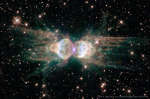 Planetary Nebula Mz3: The Ant Nebula
26.04.2015
Why isn't this ant a big sphere? Planetary nebula Mz3 is being cast off by a star similar to our Sun that is, surely, round. Why then would the gas that is streaming away create an ant-shaped nebula that is distinctly not round?
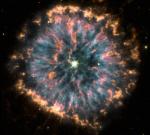 Celebrating Hubble With NGC 6751
16.04.2005
Planetary nebulae can look simple, round, and planet-like in small telescopes. But images from the orbiting Hubble Space Telescope have become well known for showing these fluorescent gas shrouds of dying Sun-like stars to possess a staggering variety of detailed symmetries and shapes.
|
January February March April May |
|||||||||||||||||||||||||||||||||||||||||||||||||