
|
You entered: face
 The Moon from Zond 8
16.07.2013
Which moon is this? Earth's. Our Moon's unfamiliar appearance is due partly to an unfamiliar viewing angle as captured by a little-known spacecraft -- the Soviet Union's Zond 8 that circled the Moon in October of 1970.
 Titan: Moon over Saturn
2.05.2025
Like Earth's moon, Saturn's largest moon Titan is locked in synchronous rotation with its planet. This mosaic of images recorded by the Cassini spacecraft in May of 2012 shows its anti-Saturn side, the side always facing away from the ringed gas giant.
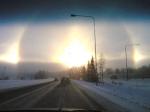 Driving Toward a Sun Halo
13.06.2006
What's happened to the Sun? Sometimes it looks like the Sun is being viewed through a large lens. In the above case, however, there are actually millions of lenses: ice crystals. As water freezes in the upper atmosphere, small, flat, six-sided, ice crystals might be formed.
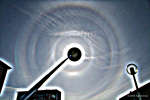 Pyramid Ice Crystal Halos Over Finland
18.06.2008
What if the atmosphere above you became one gigantic lens? This actually happens when a nearly transparent sheet of pyramid shaped ice crystals falls from the sky in a common orientation. These ice-crystals...
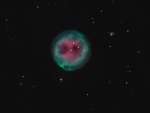 M97: The Owl Nebula
15.05.2009
The Owl Nebula is perched in the sky about 2,600 light-years away toward the bottom of the Big Dipper's bowl. Also cataloged as M97, the 97th object in Messier's well-known list, its round shape along with the placement of two large, dark "eyes" do suggest the face of a staring owl.
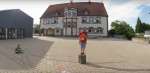 A Day in the Life of a Human Sundial
11.08.2017
Have you ever wanted to be a gnomon? Of course, a gnomon is the tall part of a sundial that casts a shadow. The gnomon's shadow moves as the Sun moves across the sky, indicating time by the shadow's position on the dial face.
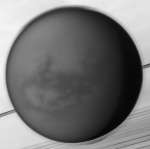 Titan: Moon over Saturn
25.05.2018
Like Earth's moon, Saturn's largest moon Titan is locked in synchronous rotation. This mosiac of images recorded by the Cassini spacecraft in May of 2012 show's its anti-Saturn side, the side always facing away from the ringed gas giant.
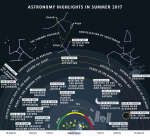 Highlights of the Summer Sky
4.06.2017
What's up in the sky this summer? The featured graphic gives a few highlights for Earth's northern hemisphere. Viewed as a clock face centered at the bottom, early summer sky events fan out toward the left, while late summer events are projected toward the right.
 Lunations
11.09.2018
Our Moon's appearance changes nightly. As the Moon orbits the Earth, the half illuminated by the Sun first becomes increasingly visible, then decreasingly visible. The featured video animates images taken by NASA's Moon-orbiting Lunar Reconnaissance Orbiter to show all 12 lunations that appear this year, 2018.
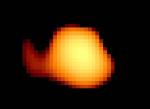 Resolving Mira
20.01.2001
Most stars appear only as points of light. In 1995, Betelgeuse became the second star, after our Sun, to have it surface resolved. Later that year, Mira was added to the list. Mira...
|
January February |
|||||||||||||||||||||||||||||||||||||||||||||||||