
|
You entered: composite image
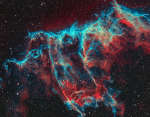 A Spectre in the Eastern Veil
1.11.2008
Menacing flying forms and garish colors are a mark of the Halloween season. They also stand out in this cosmic close-up of the eastern Veil Nebula. The Veil Nebula itself is a large supernova remnant, the expanding debris cloud from the death explosion of a massive star.
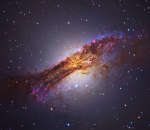 Centaurus A
19.11.2015
What's the closest active galaxy to planet Earth? That would be Centaurus A, only 11 million light-years distant. Spanning over 60,000 light-years, the peculiar elliptical galaxy is also known as NGC 5128.
 NGC 6995: The Bat Nebula
27.10.2021
Do you see the bat? It haunts this cosmic close-up of the eastern Veil Nebula. The Veil Nebula itself is a large supernova remnant, the expanding debris cloud from the death explosion of a massive star.
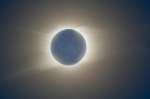 The Crown of the Sun
8.08.2008
During a total solar eclipse, the Sun's extensive outer atmosphere, or corona, is an inspirational sight. The subtle shades and shimmering features of the corona that engage the eye span a brightness range of over 10,000 to 1, making them notoriously difficult to capture in a single picture.
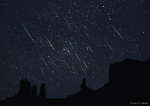 Leonids Over Monument Valley
15.11.2015
There was a shower over Monument Valley -- but not water. Meteors. The featured image -- actually a composite of six exposures of about 30 seconds each -- was taken in 2001, a year when there was a very active Leonids shower.
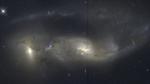 Arp 81: 100 Million Years Later
11.12.2003
From planet Earth, we view this strongly interacting pair of galaxies, cataloged as Arp 81, as they were only about 100 million years after their mutual closest approach. The havoc wreaked by gravity during...
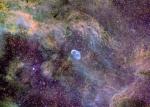 NGC 6888: A Tricolor Starfield
6.07.2006
NGC 6888, also known as the Crescent Nebula, is a cosmic bubble about 25 light-years across, blown by winds from its central, bright, massive star. Near the center of this intriguing widefield view of interstellar gas clouds and rich star fields of the constellation Cygnus, NGC 6888 is about 5,000 light-years away.
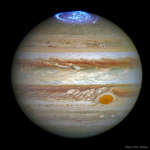 Aurorae on Jupiter
11.07.2016
Jupiter has aurorae. Like Earth, the magnetic field of the gas giant funnels charged particles released from the Sun onto the poles. As these particles strike the atmosphere, electrons are temporarily knocked away from existing gas molecules. Electric force attracts these electrons back. As the electrons recombine to remake neutral molecules, auroral light is emitted.
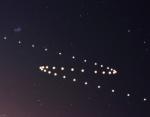 Z is for Mars
22.04.2006
This composite of images spaced about a week apart - from late July 2005 (bottom right) through February 2006 (top left) - traces the retrograde motion of ruddy-colored Mars through planet Earth's night sky. On November 7th, 2005 the Red Planet was opposite the Sun in Earth's sky (at opposition).
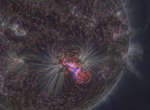 Solar Flare from a Sharper Sun
21.11.2014
Solar active region AR2192 was the largest recorded sunspot group of the last 24 years. Before rotating off the Earth-facing side of the Sun at the end of October, it produced a whopping six energetic X-class flares.
|
January February March April May June July August September |
|||||||||||||||||||||||||||||||||||||||||||||||||