
|
You entered: apod
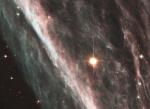 APOD: 2003 June 9 Ш The Pencil Nebula Supernova Shockwave
9.06.2003
At 500,000 kilometers per hour, a supernova shockwave plows through interstellar space. This shockwave is known as the Pencil Nebula, or NGC 2736, and is part of the Vela supernova remnant, an expanding shell of a star that exploded about 11,000 years ago.
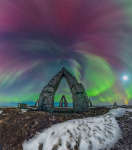 APOD: 2023 March 27 Б Aurora Over Arctic Henge
27.03.2023
Reports of powerful solar flares started a seven-hour quest north to capture modern monuments against an aurora-filled sky. The peaks of iconic Arctic Henge in Raufarhцfn in northern Iceland were already aligned with the stars: some are lined up toward the exact north from one side and toward exact south from the other.
 APOD: 2023 June 20 Б The Nandu in the Milky Way
20.06.2023
Have you seen the bird in the Milky Way? Beyond the man in the Moon, the night sky is filled with stories, and cultures throughout history have projected some of their most enduring legends onto the stars and dust above. Generations of people see these celestial icons, hear their associated stories, and pass them down.
 APOD: 2024 May 21 Б CG4: The Globule and the Galaxy
21.05.2024
Can a gas cloud eat a galaxy? It's not even close. The "claw" of this odd looking "creature" in the featured photo is a gas cloud known as a cometary globule. This globule, however, has ruptured. Cometary globules are typically characterized by dusty heads and elongated tails.
 APOD: 2025 April 21 Б Galaxy Lenses Galaxy from Webb
21.04.2025
Is this one galaxy or two? Although it looks like one, the answer is two. One path to this happening is when a small galaxy collides with a larger galaxy and ends up in the center. But in the featured image, something more rare is going on.
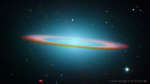 APOD: 2026 January 11 Б M104: The Sombrero Galaxy in Infrared
11.01.2026
This floating ring is the size of a galaxy. In fact, it is a galaxy -- or at least part of one: the photogenic Sombrero Galaxy, one of the largest galaxies in the nearby Virgo Cluster of Galaxies.
 APOD: 2023 December 12 Б Aurora and Milky Way over Norway
12.12.2023
What are these two giant arches across the sky? Perhaps the more familiar one, on the left, is the central band of our Milky Way Galaxy. This grand disk of stars and nebulas here appears to encircle much of the southern sky.
 APOD: 2024 September 8 Б M31: The Andromeda Galaxy
8.09.2024
The most distant object easily visible to the unaided eye is M31, the great Andromeda Galaxy. Even at some two and a half million light-years distant, this immense spiral galaxy -- spanning over 200,000 light years -- is visible, although as a faint, nebulous cloud in the constellation Andromeda.
 APOD: 2023 July 12 Б Rings and Bar of Spiral Galaxy NGC 1398
12.07.2023
Why do some spiral galaxies have a ring around the center? Spiral galaxy NGC 1398 not only has a ring of pearly stars, gas and dust around its center, but a bar of stars and gas across its center, and spiral arms that appear like ribbons farther out.
 APOD: 2023 September 11 Б Beautiful Comet Nishimura
11.09.2023
This scene would be beautiful even without the comet. By itself, the sunrise sky is an elegant deep blue on high, with faint white stars peeking through, while near the horizon is a pleasing tan.
|
January February March April May June July August September |
|||||||||||||||||||||||||||||||||||||||||||||||||