
|
You entered: all sky
 APOD: 2024 October 16 Б Colorful Aurora over New Zealand
16.10.2024
Sometimes the night sky is full of surprises. Take the sky over Lindis Pass, South Island, New Zealand one-night last week. Instead of a typically calm night sky filled with constant stars, a busy and dynamic night sky appeared.
 Rocket, Meteor, and Milky Way over Thailand
12.02.2014
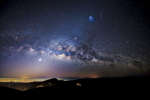
Can the night sky appear both serene and surreal? Perhaps classifiable as serene in the above panoramic image taken last Friday are the faint lights of small towns glowing across a dark foreground landscape of Doi Inthanon National Park in Thailand, as well as the numerous stars glowing across a dark background starscape.
 A 10 000 Kilometer Galactic Bridge
3.06.2022
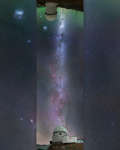
With this creative astro-collaboration you can follow the plane of our Milky Way Galaxy as it bridges northern and southern hemisphere skies. To construct the expansive composite nightscape, skies over Observatorio El Sauce...
 Venus Transits the Midnight Sun
20.06.2012
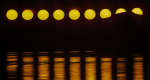
Today's solstice, the astronomical beginning of summer in the north, is at 23:09 UT when the Sun reaches the northernmost declination in its yearly trek through planet Earth's sky. While most...
 APOD: 2025 April 23 Б An Almost Everything Sky
23.04.2025
This surprising sky has almost everything. First, slanting down from the upper left and far in the distance is the central band of our Milky Way Galaxy. More modestly, slanting down from the upper right and high in Earth's atmosphere is a bright meteor.
 Andromeda in a Single Shot
25.06.2021
How far can you see? The Andromeda Galaxy, 2.5 million light years away, is the most distant object easily seen by the unaided eye. Other denizens of the night sky, like stars, clusters, and nebulae, are typically hundreds to thousands of light-years distant.
 Circling a Black Hole at its Photon Sphere
2.07.2013
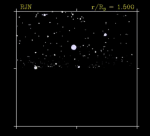
What would it look like to go right up to a black hole? One particularly interesting place near a black hole is its photon sphere, where photons can orbit in circles, a sphere 50 percent further out than the event horizon.
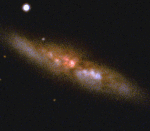 M82: An Irregular Galaxy
28.07.1995
Not all galaxies have spiral structure like our Milky Way. Many have smooth elliptical shapes, but also many have irregular shapes such as the bright sky object M82, the 82nd object on Messier's list.
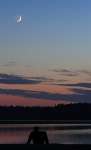 Calm, Crescent Moon, and Venus
21.05.2010
Last weekend, the Moon and Venus formed a beautiful close pair in the west after sunset, a scene enjoyed by skygazers all over the world. In this lovely view of the conjunction from Sweden, a calm lake Vallentuna lies in the foreground with sunset colors still fading behind the treeline on the far shore.
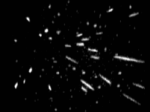 Quadrantids: Meteors in Perspective
26.01.1996
Meteor showers are caused by streams of solid particles, dust size and larger, moving as a group through space. In many cases, the orbits of these meteor streams can be identified with the dust tails of comets.
|
January February March April May June July August September |
|||||||||||||||||||||||||||||||||||||||||||||||||