
|
You entered: Earth's rotation
 APOD: 2026 August 5 Б Spokes on Saturn's B Ring
4.08.2026
DonБt get spooked by SaturnБs ghostly spokes! Today we feature a nearly two-hour timelapse of Saturn and its rings looping forwards and backwards. A day on Saturn is only 10 hours long, so two hours of observation covers quite a bit of its rotation.
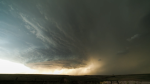 A Supercell Thunderstorm Over Texas
18.06.2013
Is that a cloud or an alien spaceship? It's an unusual and sometimes dangerous type of thunderstorm cloud called a supercell. Supercells may spawn damaging tornados, hail, downbursts of air, or drenching rain. Or they may just look impressive.
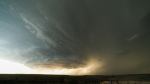 A Supercell Thunderstorm Over Texas
12.06.2021
Is that a cloud or an alien spaceship? It's an unusual and sometimes dangerous type of thunderstorm cloud called a supercell. Supercells may spawn damaging tornados, hail, downbursts of air, or drenching rain. Or they may just look impressive.
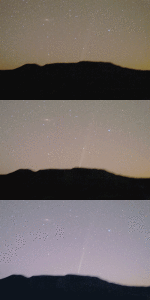 Comet Bradfield Rising
27.04.2004
Comet Bradfield has become quite a sight just before sunrise -- for those with binoculars or cameras. Although fading noticeably each day, a sky chart, a northern location, and some persistence will allow curious sky gazers to locate the cosmic snowball and its spectacular tail.
 Fermi Epicyles: The Vela Pulsar s Path
4.05.2012
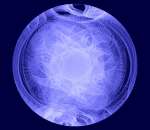
Exploring the cosmos at extreme energies, the Fermi Gamma-ray Space Telescope orbits planet Earth every 95 minutes. By design, it rocks to the north and then to the south on alternate orbits in order to survey the sky with its Large Area Telescope (LAT).
 Dwarf Planet, Bright Spot
13.05.2015
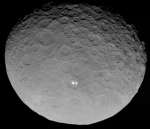
Now at Ceres, Dawn's camera recorded this closer view of the dwarf planet's northern hemisphere and one of its mysterious bright spots on May 4. A sunlit portrait of a small, dark...
 Large Sunspot Group AR 9393
11.04.2001
The largest sunspot group of the past ten years crossed the surface of the Sun late last month and early this month. The group was designated Active Region 9393 as it was the 9393rd region identified since counting officially began in 1973.
 NEAR to Asteroid Eros
4.02.2000
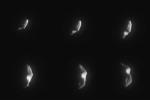
On December 23, 1998 the Near Earth Asteroid Rendezvous (NEAR) spacecraft flew by asteroid 433 Eros. The robotic spacecraft was intended to brake and orbit Eros, but an unexpected shutdown of its main engine caused this plan to be aborted.
 Elements in the Aftermath
31.07.2019
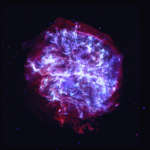
Massive stars spend their brief lives furiously burning nuclear fuel. Through fusion at extreme temperatures and densities surrounding the stellar core, nuclei of light elements ike Hydrogen and Helium are combined to heavier elements like Carbon, Oxygen, etc. in a progression which ends with Iron.
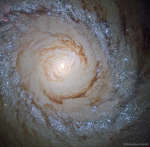 Starburst Galaxy M94 from Hubble
30.07.2022
Why does this galaxy have a ring of bright blue stars? Beautiful island universe Messier 94 lies a mere 15 million light-years distant in the northern constellation of the Hunting Dogs (Canes Venatici).
|
January February March April May June July August September October |
|||||||||||||||||||||||||||||||||||||||||||||||||