
|
You entered: star
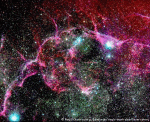 Vela Supernova Remnant in Optical
13.07.1997
About 11,000 years ago a star in the constellation of Vela exploded. This bright supernova may have been visible to the first human farmers. Today the Vela supernova remnant marks the position of a relatively close and recent explosion in our Galaxy. A roughly spherical, expanding shock wave is visible in X-rays.
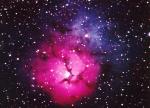 The Trifid Nebula in Red, White and Blue
8.12.1997
Three dark dust lanes give the picturesque Trifid Nebula its name. The red and blue colors of the Trifid Nebula are present in different regions and are created by different processes. A big bright star near the center of the red region appears white hot and emits light so energetic
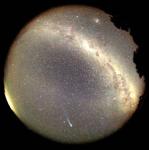 A Southern Sky View
26.02.1998
From horizon to horizon, the night sky above Loomberah, New South Wales, Australia was photographed by astronomer Gordon Garradd on March 22, 1996. Garradd used a home made all-sky camera with a fish-eye lens, resulting in a circular 200 degree field of view.
 APOD: 2023 June 5 Б In the Center of the Trifid Nebula
5.06.2023
What's happening at the center of the Trifid Nebula? Three prominent dust lanes that give the Trifid its name all come together. Mountains of opaque dust appear near the bottom, while other dark filaments of dust are visible threaded throughout the nebula.
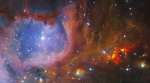 Messier 43
10.07.2015
Often imaged but rarely mentioned, Messier 43 is a large star forming region in its own right. It's just part of the star forming complex of gas and dust that includes the larger, more famous neighboring Messier 42, the Great Orion Nebula.
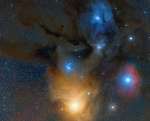 Comet Clark is near the Edge.
27.05.2017
Sweeping through this stunning field of view, Comet 71P/Clark really is in the foreground of these cosmic clouds. The 2 panel telescopic mosaic is color enhanced and is about 5 degrees (10 full moons) across.
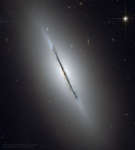 Edge On Galaxy NGC 5866
15.11.2020
Why is this galaxy so thin? Many disk galaxies are just as thin as NGC 5866, pictured here, but are not seen edge-on from our vantage point. One galaxy that is situated edge-on is our own Milky Way Galaxy.
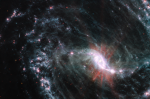 Barred Spiral Galaxy NGC 1365 from Webb
18.02.2023
A mere 56 million light-years distant toward the southern constellation Fornax, NGC 1365 is an enormous barred spiral galaxy about 200,000 light-years in diameter. That's twice the size of our own barred spiral Milky Way.
 APOD: 2023 May 22 Б Supernova Discovered in Nearby Spiral Galaxy M101
22.05.2023
A nearby star has exploded and humanity's telescopes are turning to monitor it. The supernova, dubbed SN 2023ifx, was discovered by Japanese astronomer Koichi Itagaki three days ago and subsequently located on automated images from the Zwicky Transient Facility two days earlier.
 Barred Spiral Galaxy NGC 1365 from Webb
13.11.2024
A mere 56 million light-years distant toward the southern constellation Fornax, NGC 1365 is an enormous barred spiral galaxy about 200,000 light-years in diameter. That's twice the size of our own barred spiral Milky Way.
|
January February March April May June July August September |
|||||||||||||||||||||||||||||||||||||||||||||||||