
|
You entered: telescope
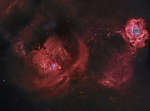 Field of Rosette
14.02.2010
What surrounds the florid Rosette nebula? To better picture this area of the sky, the famous flowery emission nebula on the far right has been captured recently in a deep and dramatic wide field image that features several other sky highlights.
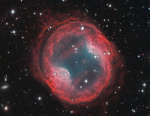 Planetary Nebula PK 164 31
30.10.2012
Is this what will become of our Sun? Quite possibly. The bubble of expanding gas pictured above is the planetary nebula PK 164 +31.1, the remnants of the atmosphere of a Sun-like star expelled as its supply of fusion-able core hydrogen became depleted.
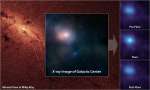 The Black Hole in the Milky Way
2.11.2012
At the center of our Milky Way Galaxy, a mere 27,000 light-years away, lies a black hole with 4 million times the mass of the Sun. Fondly known as Sagittarius A* (pronounced A-star)...
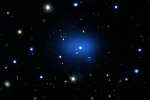 JKCS041: The Farthest Galaxy Cluster Yet Measured
28.10.2009
What if we could see back to the beginning of the universe? We can -- since it takes the age of the universe for light to cross the universe. Peering at distant objects, therefore, tells us about how the universe used to be, even near its beginning.
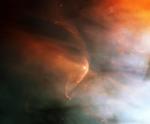 LL Orionis: When Cosmic Winds Collide
15.11.2003
This arcing, graceful structure is actually a bow shock about half a light-year across, created as the wind from young star LL Orionis collides with the Orion Nebula flow. Adrift in Orion's stellar...
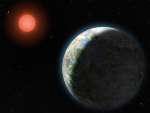 Zarmina s World
1.10.2010
A mere 20 light-years away in the constellation Libra, red dwarf star Gliese 581 has received much scrutiny by astronomers in recent years. Earthbound telescopes had detected the signatures of multiple planets orbiting...
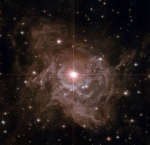 Nearby Cepheid Variable RS Pup
9.09.2013
It is one of the most important stars in the sky. This is partly because, by coincidence, it is surrounded by a dazzling reflection nebula. Pulsating RS Puppis, the brightest star in the image center, is some ten times more massive than our Sun and on average 15,000 times more luminous.
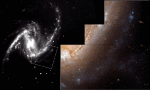 Hubble's Constant And The Expanding Universe (I)
13.05.1996
Our Universe is expanding. Distant galaxies appear to recede from us at ever-increasing speeds. What is the rate of expansion? How long has it been expanding? What will be its ultimate fate? Two groups of astronomers are searching vigorously for answers to these fundamental questions using the Hubble Space Telescope (HST).
 The Mystery of the Fading Star
8.01.2010
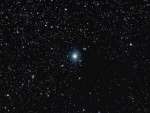
Every 27 years Epsilon Aurigae fades, remaining dim for roughly two years before growing bright again. Since the 19th century, astronomers have studied the mystery star, eventually arguing that Epsilon Aur, centered in this telescopic skyview, was actually undergoing a long eclipse by a dark companion object.
 Giant Galaxy NGC 6872
3.04.2011
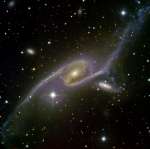
Over 400,000 light years across NGC 6872 is an enormous spiral galaxy, at least 4 times the size of our own, very large, Milky Way. About 200 million light-years distant, toward the southern...
|
January February March April May June July August September |
|||||||||||||||||||||||||||||||||||||||||||||||||