
|
You entered: stars
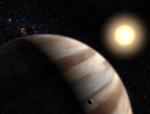 Extra Solar Planetary Atmosphere Detected
28.11.2001
By directly detecting the atmosphere of a planet outside our Solar System, humanity has taken another small step toward finding extraterrestrial life. The unexpected detection by David Charbonneau (Caltech) and associates came from Hubble Space Telescope observations of Sun-like star HD 209458.
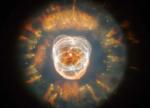 The Eskimo Nebula from Hubble
7.12.2003
In 1787, astronomer William Herschel discovered the Eskimo Nebula. From the ground, NGC 2392 resembles a person's head surrounded by a parka hood. In 2000, the Hubble Space Telescope imaged the Eskimo Nebula. From space, the nebula displays gas clouds so complex they are not fully understood.
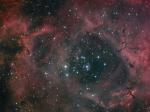 Dust and Light in the Rosette Nebula
14.02.2006
What creates the cosmic dust sculptures in the Rosette Nebula? Noted for the common beauty of its overall shape, parts of the Rosette Nebula, also known as NGC 2244, show beauty even when viewed up close.
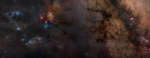 Dark River Wide Field
19.07.2010
A Dark River of dust seems to run from our Galactic Center, then pool into a starfield containing photogenic sky wonders. Scrolling right will reveal many of these objects including (can you find?)...
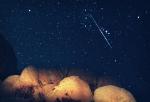 Bright Meteor, Dark Sky
20.08.1997
Has Orion the Hunter acquired a new weapon? If you turn your head sideways (counterclockwise) you might notice the familiar constellation of Orion, particularly the three consecutive bright stars that make up Orion's belt.
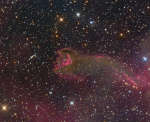 CG4: A Ruptured Cometary Globule
13.05.2014
Can a gas cloud grab a galaxy? It's not even close. The "claw" of this odd looking "creature" in the above photo is a gas cloud known as a cometary globule. This globule, however, has ruptured. Cometary globules are typically characterized by dusty heads and elongated tails.
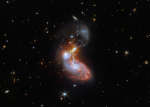 Merging Galaxy Pair IIZw096
2.12.2022
Bright at infrared wavelengths, this merging galaxy pair is some 500 million light-years away toward the constellation Delphinus. The cosmic mashup is seen against a background of even more distant galaxies, and occasional spiky foreground stars. But the galaxy merger itself spans about 100,000 light-years in this deep James Webb Space Telescope image.
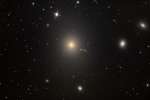 M87: Elliptical Galaxy with Jet
20.05.2010
In spiral galaxies, majestic winding arms of young stars, gas, and dust rotate in a flat disk around a bulging galactic nucleus. But elliptical galaxies seem to be simpler. Lacking gas and dust to form new stars, their randomly swarming older stars, give them an ellipsoidal (egg-like) shape. Still, elliptical galaxies can be very large.
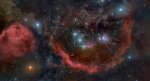 Orion: Head to Toe
23.10.2010
Cradled in cosmic dust and glowing hydrogen, stellar nurseries in Orion the Hunter lie at the edge of a giant molecular cloud some 1,500 light-years away. Spanning nearly 25 degrees, this breath-taking vista stretches across the well-known constellation from head to toe (left to right).
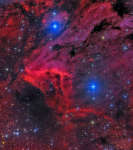 The Pelican Nebula in Red and Blue
1.03.2021
The Pelican Nebula is changing. The entire nebula, officially designated IC 5070, is divided from the larger North America Nebula by a molecular cloud filled with dark dust. The Pelican, however, is particularly interesting because it is an unusually active mix of star formation and evolving gas clouds.
|
January February March April May June July August September |
|||||||||||||||||||||||||||||||||||||||||||||||||