
|
You entered: southern sky
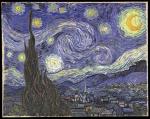 Starry Night
26.06.2006
The painting Starry Night is one of the most famous icons of the night sky ever created. The scene was painted by Vincent van Gogh in southern France in 1889. The swirling style of Starry Night appears, to many, to make the night sky come alive.
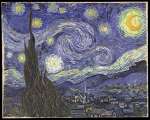 Starry Night by Vincent van Gogh
11.10.2009
The painting Starry Night is one of the most famous icons of the night sky ever created. The scene was painted by Vincent van Gogh in southern France in 1889. The swirling style of Starry Night appears, to many, to make the night sky come alive.
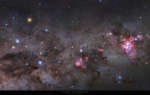 Southern Cross to Eta Carinae
25.04.2019
Tracking along the southern Milky Way this beautiful celestial mosaic was recorded under dark Brazilian skies. Spanning some 20 degrees it actually starts with the dark expanse of the Coalsack nebula at the lower left, tucked under an arm of the Southern Cross.
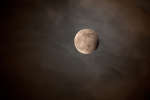 Blue Moon Eclipse
1.01.2010
The International Year of Astronomy 2009 ended with a Blue Moon and a partial lunar eclipse, as the second Full Moon of December grazed the Earth's shadow on December 31st. The New Year...
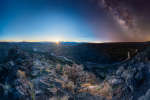 A Flow of Time
8.04.2020
This surreal timelapse, landscape, panorama spans predawn, blue hour, and sunrise skies. Close to the start of planet Earth's northern hemisphere spring, the flow of time was captured between 4:30 and 7:00 am from a location overlooking northern New Mexico's Rio Grande Valley.
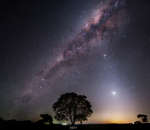 A Light and Dusty Night
1.10.2021
Posing as a brilliant evening star, Venus lies near the western horizon in this southern hemisphere, early spring, night skyscape. To create the composite view exposures tracking the sky and fixed for the foreground were taken on September 25 from Cascavel in southern Brazil.
 APOD: 2023 June 21 Б Three Sun Paths
20.06.2023
Does the Sun follow the same path every day? No. The Sun's path changes during the year, tracing a longer route during the summer than the winter. Pictured here...
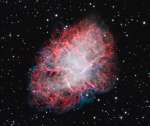 M1: The Incredible Expanding Crab
5.09.2013
The Crab Nebula is cataloged as M1, the first on Charles Messier's famous list of things which are not comets. In fact, the Crab is now known to be a supernova remnant, an expanding cloud of debris from the explosion of a massive star.
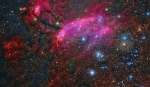 IC 4628: The Prawn Nebula
8.12.2016
South of Antares, in the tail of the nebula-rich constellation Scorpius, lies emission nebula IC 4628. Nearby hot, massive stars, millions of years young, irradiate the nebula with invisible ultraviolet light, stripping electrons from atoms. The electrons eventually recombine with the atoms to produce the visible nebular glow, dominated by the red emission of hydrogen.
 Gemini Observatory North
14.10.2016
It does look like a flying saucer, but this technologically advanced structure is not here to deliver the wise extraterrestrial from the scifi classic movie The Day the Earth Stood Still. It is here to advance our knowledge of the Universe though.
|
January February March April May |
|||||||||||||||||||||||||||||||||||||||||||||||||