
|
You entered: magellanic clouds
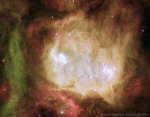 Halloween and the Ghost Head Nebula
24.10.2021
Halloween's origin is ancient and astronomical. Since the fifth century BC, Halloween has been celebrated as a cross-quarter day, a day halfway between an equinox (equal day / equal night) and a solstice (minimum day / maximum night in the northern hemisphere).
 N49 s Cosmic Blast
4.07.2003
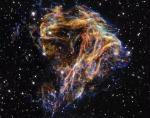
Scattered debris from a cosmic supernova explosion lights up the sky in this gorgeous composited image based on data from the Hubble Space Telescope. Cataloged as N49, these glowing filaments of shocked gas span about 30 light-years in our neighboring galaxy, the Large Magellanic Cloud.
 Tentacles of the Tarantula Nebula
18.05.2010
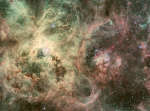
The largest, most violent star forming region known in the whole Local Group of galaxies lies in our neighboring galaxy the Large Magellanic Cloud (LMC). Were the Tarantula Nebula at the distance of the Orion Nebula -- a local star forming region -- it would take up fully half the sky.
 Cloud, Clusters and Comet Siding Spring
4.09.2014
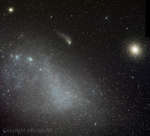
On October 19th, a good place to watch Comet Siding Spring will be from Mars. Then, this inbound visitor (C/2013 A1) to the inner solar system, discovered in January 2013 by Robert McNaught at Australia's Siding Spring Observatory, will pass within 132,000 kilometers of the Red Planet.
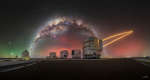 APOD: 2026 March 10 Б Sky Glows over Paranal Observatory
10.03.2026
Are lasers from giant telescopes being used to defend the Earth? No. Lasers shot from telescopes are now commonly used to help increase the accuracy of astronomical observations. In some directions, Earth atmosphere-induced fluctuations in starlight can indicate how the air mass over a telescope is changing, but in other directions, no bright star exists.
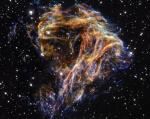 N49's Cosmic Blast
6.03.2004
Scattered debris from a cosmic supernova explosion lights up the sky in this gorgeous composited image based on data from the Hubble Space Telescope. Cataloged as N49, these glowing filaments of shocked gas span about 30 light-years in our neighboring galaxy, the Large Magellanic Cloud.
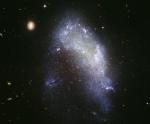 NGC 1427A: Galaxy in Motion
4.03.2005
In this tantalizing image, young blue star clusters and pink star-forming regions abound in NGC 1427A, a galaxy in motion. The small irregular galaxy's swept back outline points toward the top of this...
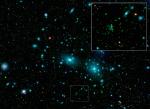 Dwarf Galaxies in the Coma Cluster
31.05.2007
In visible light images, over a thousand galaxies are seen to lie within a volume about 20 million light-years across in the rich Coma Galaxy Cluster. But infrared images of the Coma Cluster have now been used to add thousands more to the Coma's galaxy count in the form of previously undiscovered dwarf galaxies.
 The Tarantula Zone
23.08.2003
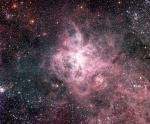
The Tarantula Nebula is more than 1,000 light-years across - a giant emission nebula within our neighboring galaxy the Large Magellanic Cloud. Inside this cosmic arachnid lies a central young cluster of massive stars, cataloged as R136, whose intense radiation and strong winds have helped energize the nebular glow and shape the spidery filaments.
 NGC 4449: Close up of a Small Galaxy
25.02.2011
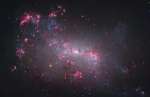
Grand spiral galaxies often seem to get all the glory. Their young, blue star clusters and pink star forming regions along sweeping spiral arms are guaranteed to attract attention. But small irregular galaxies form stars too, like NGC 4449, about 12 million light-years distant.
|
January February March April May June July August |
||||||||||||||||||||||||||||||||||||||||||||||||||||||||