
|
You entered: hot star
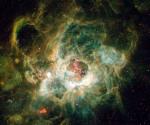 NGC 604: Giant Stellar Nursery
1.11.2002
Scattered within this cavernous nebula, cataloged as NGC 604, are over 200 newly formed hot, massive, stars. At 1,500 light-years across, this expansive cloud of interstellar gas and dust is effectively a giant stellar nursery located some three million light-years distant in the spiral galaxy, M33.
 APOD: 2023 November 20 Б The Horsehead Nebula
19.11.2023
Sculpted by stellar winds and radiation, a magnificent interstellar dust cloud by chance has assumed this recognizable shape. Fittingly named the Horsehead Nebula, it is some 1,500 light-years distant, embedded in the vast Orion cloud complex.
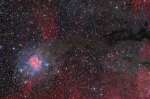 Cocoon Nebula Wide Field
13.09.2012
In this crowded starfield covering over 2 degrees within the high flying constellation Cygnus, the eye is drawn to the Cocoon Nebula. A compact star forming region, the cosmic Cocoon punctuates a long trail of obscuring interstellar dust clouds.
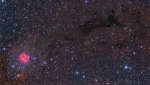 Cocoon Nebula Wide Field
18.09.2014
In this crowded starfield covering over 2 degrees within the high flying constellation Cygnus, the eye is drawn to the Cocoon Nebula. A compact star forming region, the cosmic Cocoon punctuates a long trail of obscuring interstellar dust clouds.
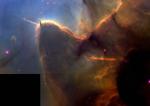 Starbirth in the Trifid Nebula
7.06.1999
Tremendous pillars of gas and dust are being boiled away in the Trifid Nebula. In the center of the picturesque Trifid lies a young hot star, located above and to the right of this picture. As soon as it was born, the massive star scorched its surroundings with bright and
 Stars and Dust in Corona Australis
7.01.2015
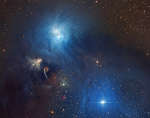
Cosmic dust clouds and young, energetic stars inhabit this telescopic vista, less than 500 light-years away toward the northern boundary of Corona Australis, the Southern Crown. The dust clouds effectively block light from more distant background stars in the Milky Way.
 Aurigae Nebulae
24.02.2012
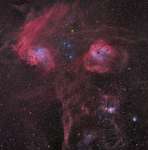
Rich in star clusters and nebulae, the ancient constellation of Auriga, the Charioteer, rides high in northern winter night skies. Composed from narrow and broadband filter data and spanning nearly 8 Full Moons (4 degrees) on the sky, this deep telescopic view recorded in January shows off some of Auriga's celestial bounty.
 The Stars of NGC 1705
23.04.2003
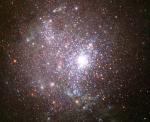
Some 2,000 light-years across, NGC 1705 is small as galaxies go, similar to our Milky Way's own satellite galaxies, the Magellanic Clouds. At a much larger distance of 17 million light-years...
 Infrared Orion from WISE
18.01.2015
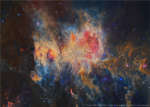
The Great Nebula in Orion is an intriguing place. Visible to the unaided eye, it appears as a small fuzzy patch in the constellation of Orion. But this image, an illusory-color four-panel mosaic taken...
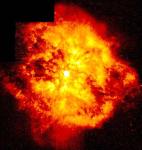 WR124: Stellar Fireball
8.11.1998
Some stars explode in slow motion. Rare, massive Wolf-Rayet stars are so tumultuous and hot they are disintegrating right before our telescopes. Glowing gas globs each over 30 times more massive than the Earth are being expelled by a violent stellar wind.
|
January February |
|||||||||||||||||||||||||||||||||||||||||||||||||