
|
You entered: gravity
 APOD: 2025 July 22 Б A Double Detonation Supernova
22.07.2025
Can some supernovas explode twice? Yes, when the first explosion acts like a detonator for the second. This is a leading hypothesis for the cause of supernova remnant (SNR) 0509-67
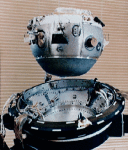 Galileo's Jupiter Probe
7.12.1995
Today, at about 5:00 pm EST, this 750 pound probe from NASA's robot spacecraft Galileo will plummet into Jupiter becoming the first probe to fly through the atmosphere of a gas giant planet.
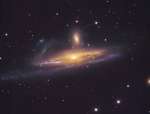 Galaxies in the River
27.11.2008
Large galaxies grow by eating small ones. Even our own galaxy practices galactic cannibalism, absorbing small galaxies that get too close and are captured by the Milky Way's gravity. In fact, the practice...
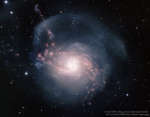 APOD: 2026 April 5 Б NGC 3310: A Starburst Spiral Galaxy
5.04.2026
The party is still going on in spiral galaxy NGC 3310. Roughly 100 million years ago, NGC 3310 likely collided with a smaller galaxy causing the large spiral galaxy to light up with a tremendous burst of star formation.
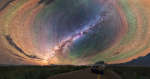 Colorful Airglow Bands Surround Milky Way
6.03.2018
Why would the sky glow like a giant repeating rainbow? Airglow. Now air glows all of the time, but it is usually hard to see. A disturbance however -- like an approaching storm -- may cause noticeable rippling in the Earth's atmosphere.
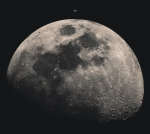 APOD: 2026 April 15 Б The ISS Transits the Moon
15.04.2026
Nope, that is not an alien spaceship landing on the Moon! This is an image of the International Space Station (ISS) as it begins to transit in front of the Moon. The ISS is in low-Earth orbit (LEO) where it wizzes around the Earth every 90 minutes.
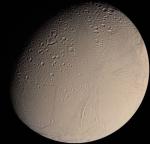 Ski Enceladus
24.01.2002
A small inner moon of Saturn, Enceladus is only about 500 kilometers in diameter. But the cold, distant world does reflect over 90 percent of the sunlight it receives, giving its surface about the same reflectivity as new-fallen snow.
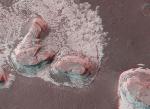 3D Mars: Northern Terra Meridiani
28.08.2002
In this spectacular 3D stereoscopic view from orbit, steep-sided, flat-topped hills stand above the Terra Meridiani region of Mars. Seen best with red/blue glasses (red for the left eye), the structures are reminiscent of buttes and mesas found in southwestern areas of the North American continent on planet Earth.
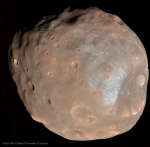 Phobos: Doomed Moon of Mars
22.11.2015
This moon is doomed. Mars, the red planet named for the Roman god of war, has two tiny moons, Phobos and Deimos, whose names are derived from the Greek for Fear and Panic. These...
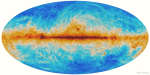 Magnetic Streamlines of the Milky Way
17.06.2020
What role do magnetic fields play in interstellar physics? Analyses of observations by ESA's Planck satellite of emission by small magnetically-aligned dust grains reveal previously unknown magnetic field structures in our Milky Way Galaxy -- as shown by the curvy lines in the featured full-sky image.
|
January February March April May June July August September |
|||||||||||||||||||||||||||||||||||||||||||||||||