
|
You entered: dark
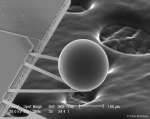 A Force from Empty Space: The Casimir Effect
6.12.2015
This tiny ball provides evidence that the universe will expand forever. Measuring slightly over one tenth of a millimeter, the ball moves toward a smooth plate in response to energy fluctuations in the vacuum of empty space.
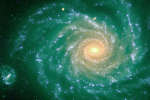 Grand Spiral Galaxy NGC 1232
24.08.2008
Galaxies are fascinating not only for what is visible, but for what is invisible. Grand spiral galaxy NGC 1232, captured in detail by one of the new Very Large Telescopes, is a good example.
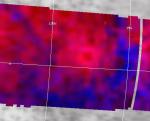 Crater On Ice
14.07.2000
Impact craters are common on Earth's moon but on Jupiter's large ice moon Europa, they are very rare. Over time, both bodies have been subjected to an intense pounding by the solar system's formative debris, but geological activity on Europa's surface seems to have erased most of these impact scars.
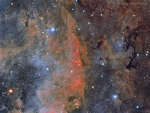 Colorful Star Clouds in Cygnus
22.04.2015
Stars can form in colorful surroundings. Featured here is a star forming region rich in glowing gas and dark dust toward the constellation of the Swan (Cygnus), near the bright star Sadr. This region, which spans about 50 light years, is part of the Gamma Cygni nebula which lies about 1,800 light years distant.
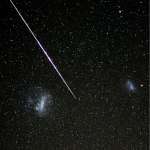 Meteor between the Clouds
20.11.2009
This bright meteor streaked through dark night skies over Sutherland, South Africa on November 15. Potentially part of the annual Leonid meteor shower, its sudden, brilliant appearance, likened to a camera's flash, was captured by chance as it passed between two clouds.
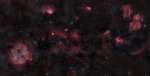 Cepheus: Trunk to Bubble
9.09.2010
Star clusters, glowing nebulae and dark dust clouds abound in Cepheus, royal constellation of the northern hemisphere. You can follow them in amazing detail across this broad skyscape, a mosaic of telescopic images spanning about 17 degrees. Beginning at the lower left, the large emission nebula is cataloged as IC 1396.
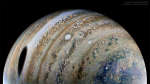 Moon Shadow on Jupiter
27.04.2022
What is that large dark spot on Jupiter? It's the shadow of Io, one of Jupiter's largest moons. When Jupiter's moons cross between the Jovian giant and the Sun, they created shadows just like when the Earth's moon crosses between the Earth and the Sun.
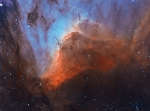 Pelican Nebula Close Up
3.08.2017
The prominent ridge of emission featured in this vivid skyscape is designated IC 5067. Part of a larger emission region with a distinctive shape, popularly called The Pelican Nebula, the ridge spans about 10 light-years and follows the curve of the cosmic pelican's head and neck.
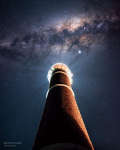 Milky Way over Uruguayan Lighthouse
19.11.2019
Can a lighthouse illuminate a galaxy? No, but in the featured image, gaps in light emanating from the Jose Ignacio Lighthouse in Uruguay appear to match up nicely, although only momentarily and coincidently, with dark dust lanes of our Milky Way Galaxy. The bright dot on the right is the planet Jupiter.
 Helping Hand in Cassiopeia
8.11.2024
Drifting near the plane of our Milky Way galaxy these dusty molecular clouds seem to extend a helping hand on a cosmic scale. Part of a local complex of star-forming interstellar clouds they include LDN 1358, 1357, and 1355 from American astronomer Beverly Lynds' 1962 Catalog of Dark Nebulae.
|
January February March April May June July August September |
|||||||||||||||||||||||||||||||||||||||||||||||||