
|
You entered: Earth orbit
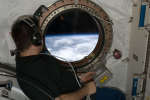 Home from Above
29.12.2008
There's no place like home. Peering out of the window of the International Space Station (ISS), astronaut Greg Chamitoff takes in the planet on which we were all born. About 350 kilometers up, the ISS is high enough so that the Earth's horizon appears clearly curved.
 Vega and Comet 12P Pons-Brooks
7.12.2023
On December 4, periodic Comet 12P/Pons-Brooks shared this telescopic field of view with Vega, alpha star of the northern constellation Lyra. Fifth brightest star in planet Earth's night, Vega is some 25 light-years distant while the much fainter comet was about 21 light-minutes away.
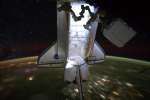 Endeavour s Starry Night
2.06.2011
This luminous night view of the space shuttle orbiter Endeavour, docked with the International Space Station for a final time, was captured on May 28. Orbiting 350 kilometers above planet Earth, Endeavour's payload bay is lit up as it hurtles through Earth's shadow at 27,000 miles per hour.
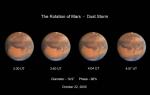 October Mars
28.10.2005
This October, Mars has become a bright, yellowish star in planet Earth's sky as it approaches oppositon, the period when Mars and Earth pass close as they orbit the Sun. How close is Mars? A mere 70 million kilometers or so, close enough to allow Earth-bound astronomers excellent views of the alluring Red Planet.
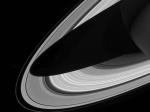 A Shadow on the Rings of Saturn
21.07.2004
This picture of Saturn could not have been taken from Earth. No Earth based picture could possibly view the night side of Saturn and the corresponding shadow cast across Saturn's rings. Since Earth is much closer to the Sun than Saturn, only the day side of the planet is visible from the Earth.
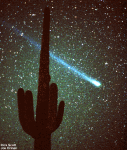 Comet Hyakutake and a Cactus
1.05.1996
Comet Hyakutake is shown photographed the night of March 27 in Arizona, USA, with a cactus in the foreground. Polaris, the north star, is the bright star seen just to the upper right of the comet's head. Today Comet Hyakutake reaches its closest approach to the Sun.
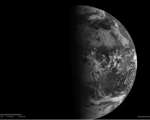 Equinox on a Spinning Earth
21.09.2021
When does the line between night and day become vertical? Today. Today is an equinox on planet Earth, a time of year when day and night are most nearly equal. At an equinox, the Earth's terminator -- the dividing line between day and night -- becomes vertical and connects the north and south poles.
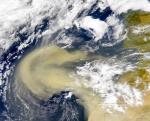 Dust Storm on Planet Earth
2.03.2000
From low Earth orbit, NASA's SeaWIFS instrument records ocean color, tracking changes in our water world's climate and biosphere. But even an ocean planet can have dust storms. On February 26th, SeaWIFS...
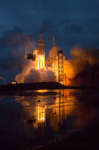 Orion Launch
5.12.2014
Headed for two orbits of planet Earth and a splashdown in the Pacific, Orion blazed into the early morning sky on Friday at 7:05am ET. The spacecraft was launched atop a United Launch Aliance Delta IV Heavy rocket from Cape Canaveral Air Force Station in Florida.
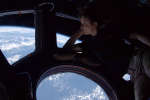 Home from Above
14.11.2010
There's no place like home. Peering out of the windows of the International Space Station (ISS), astronaut Tracy Caldwell Dyson takes in the planet on which we were all born, and to which she would soon return.
|
January February March April May June July August September October |
|||||||||||||||||||||||||||||||||||||||||||||||||