
|
You entered: Earth's rotation
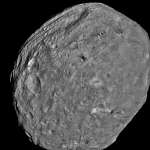 Asteroid Vesta Full Frame
2.08.2011
Why is the northern half of asteroid Vesta more heavily cratered than the south? No one is yet sure. This unexpected mystery has come to light only in the past few weeks since the robotic Dawn mission became the first spacecraft to orbit the second largest object in the asteroid belt between Mars and Jupiter.
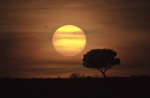 Sunspot Group 1429 and the Distant Sun
19.03.2012
What's that on the Sun? Over the past two weeks, one of the most energetic sunspot regions of recent years crossed the face of the Sun. Active Region 1429, visible above...
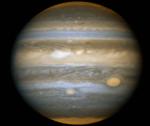 Jupiter and the Red Spots
5.05.2006
Jupiter's Great Red Spot is a swirling storm seen for over 300 years, since the beginning of telescopic observations. But in February 2006, planetary imager Christopher Go noticed it had been joined by Red Spot Jr - formed as smaller whitish oval-shaped storms merged and then developed the remarkable reddish hue.
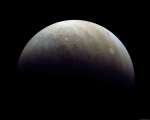 Southern Jupiter from Perijove 3
17.12.2016
Southern Jupiter looms some 37,000 kilometers away in this JunoCam image from December 11. The image data was captured near Juno's third perijove or closest approach to Jupiter, the spacecraft still in its 53 day long looping orbit.
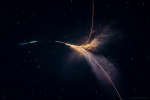 Falcon 9 Boostback
12.03.2020
Short star trails appear in this single 84 second long exposure, taken on March 6 from a rotating planet. The remarkable scene also captures the flight of a Falcon 9 rocket and Dragon cargo spacecraft over Cape Canaveral Air Force Station shortly after launch, on a resupply mission bound for the International Space Station.
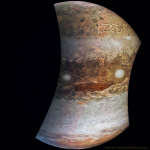 A Face in the Clouds of Jupiter from Juno
8.06.2021
What do you see in the clouds of Jupiter? On the largest scale, circling the planet, Jupiter has alternating light zones and reddish-brown belts. Rising zone gas, mostly hydrogen and helium, usually swirls around regions of high pressure. Conversely, falling belt gas usually whirls around regions of low pressure, like cyclones and hurricanes on Earth.
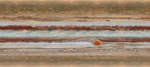 Jupiter in 2015
24.10.2015
Two remarkable global maps of Jupiter's banded cloud tops can be compared by just sliding your cursor over this sharp projection (or follow this link) of image data from the Hubble Space Telescope.
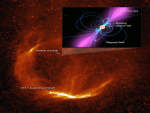 A Dark Pulsar in CTA 1
21.10.2008
Where's the pulsar? Previously, the nebula CTA 1 showed an expanding supernova remnant, a jet, and a point source expected to be a pulsar -- a rotating neutron star producing pulses at radio energies. But no radio pulses were detected.
 The Crew 7 Nebula
31.08.2023
Not the James Webb Space Telescope's latest view of a distant galactic nebula, this illuminated cloud of gas and dust dazzled early morning spacecoast skygazers on August 26. The snapshot was taken about...
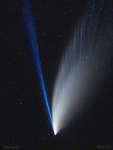 APOD: 2020 July 22 Б The Structured Tails of Comet NEOWISE
22.07.2020
What is creating the structure in Comet NEOWISE's tails? Of the two tails evident, the blue ion tail on the left points directly away from the Sun and is pushed out by the flowing and charged solar wind.
|
January February March April May June July August September October |
|||||||||||||||||||||||||||||||||||||||||||||||||