
|
You entered: naked eye
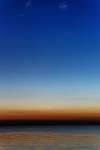 Dawn s Grande Finale
4.06.2011
After more than a month, the lovely lineup of four naked-eye planets in dawn skies is coming to a close. Still, on May 31st a slender Moon joined the grouping along the eastern horizon for a final celestial performance, presented in this early morning scene from a beach near Buenos Aires, Argentina.
 M7: Open Star Cluster in Scorpius
13.07.2016
M7 is one of the most prominent open clusters of stars on the sky. The cluster, dominated by bright blue stars, can be seen with the naked eye in a dark sky in the tail of the constellation of the Scorpion (Scorpius).
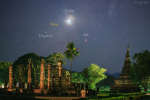 Nova over Thailand
21.11.2016
A nova in Sagittarius is bright enough to see with binoculars. Detected last month, the stellar explosion even approached the limit of naked-eye visibility last week. A classical nova results from a thermonuclear explosion...
 Mars and the Beehive
10.06.2023
This month, bright Mars and brilliant Venus are the prominent celestial beacons in planet Earth's western skies after sunset. Wandering through the constellation Cancer the Crab, the Red Planet was captured here on the evening of June 3 near the stars of open cluster Messier 44.
 Globular Star Cluster 47 Tuc
16.01.2011
Globular star cluster 47 Tucanae is a jewel of the southern sky. Also known as NGC 104, it roams the halo of our Milky Way Galaxy along with some 200 other globular star clusters.
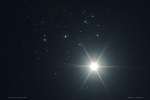 Venus and the Sisters
6.04.2012
After wandering about as far from the Sun on the sky as Venus can get, the brilliant evening star crossed paths with the Pleiades star cluster earlier this week. The beautiful conjunction was enjoyed by skygazers around the world. Taken on April 2, this celestial group photo captures the view from Portal, Arizona, USA.
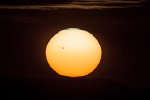 Sunspot at Sunset
8.01.2014
Sunsets may be the most watched celestial event, but lately sunsets have even offered something extra. A sunspot so large it was visible to the naked eye is captured in Swiss skies in this...
 M7: Open Star Cluster in Scorpius
8.11.2009
M7 is one of the most prominent open clusters of stars on the sky. The cluster, dominated by bright blue stars, can be seen with the naked eye in a dark sky in the tail of the constellation of the Scorpion (Scorpius).
 PanSTARRS from France
16.03.2013
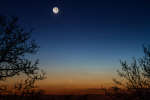
Still looking for that comet? Comet PanSTARRS (C/2011 L4) naked-eye appearance in the northern hemisphere is described by successful comet spotters as a dim star with faint a tail. If you want to catch it the next few days could be your best bet.
 M7: Open Star Cluster in Scorpius
7.01.2014
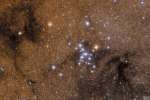
M7 is one of the most prominent open clusters of stars on the sky. The cluster, dominated by bright blue stars, can be seen with the naked eye in a dark sky in the tail of the constellation of the Scorpion (Scorpius).
|
January February March April May June July August September October |
|||||||||||||||||||||||||||||||||||||||||||||||||