
|
You entered: main sequence
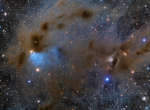 Young Stars and Dusty Nebulae in Taurus
30.03.2017
This complex of dusty nebulae lingers along the edge of the Taurus molecular cloud, a mere 450 light-years distant. Stars are forming on the cosmic scene. Composed from almost 40 hours of image data...
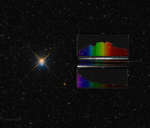 Beautiful Albireo AB
24.02.2022
Beta Cygni is a single bright star to the naked eye. About 420 light-years away it marks the foot of the Northern Cross, famous asterism in the constellation Cygnus. But a view through...
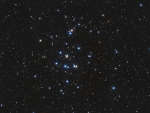 M44: The Beehive Cluster
22.02.2014
A mere 600 light-years away, M44 is one of the closest star clusters to our solar system. Also known as the Praesepe or the Beehive cluster its stars are young though, about 600 million years old compared to our Sun's 4.5 billion years.
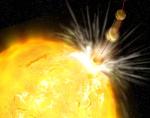 HD 82943: Planet Swallower
18.05.2001
Stars like HD 82943 are main sequence G dwarf stars with temperatures and compositions similar to the Sun. Also like the Sun, HD 82943 is known to have at least two giant planets, but unlike gas giants in our solar system their orbits are not nearly circular and bring them closer to the parent star.
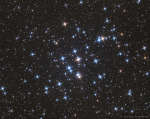 M44: The Beehive Cluster
30.04.2022
A mere 600 light-years away, M44 is one of the closest star clusters to our solar system. Also known as the Praesepe or the Beehive cluster its stars are young though, about 600 million years old compared to our Sun's 4.5 billion years.
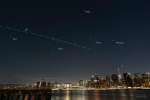 Eclipse in the City
12.11.2022
A darker Moon sets over Manhattan in this night skyscape. The 16 frame composite was assembled from consecutive exposures recorded during the November 8 total lunar eclipse. In the timelapse sequence stars leave short trails above the urban skyline, while the Moon remains immersed in Earth's shadow.
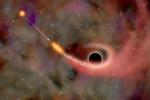 X Rays Indicate Star Ripped Up by Black Hole
24.02.2004
What could rip a star apart? A black hole. Giant black holes in just the right mass range would pull on the front of a closely passing star much more strongly than on the back.
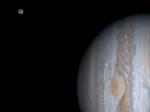 Jupiter, Europa, and Callisto
2.01.2001
As the robot Cassini spacecraft rounds Jupiter on its way toward Saturn, it has taken a sequence of images of the gas giant with its four largest moons. Previously released images have highlighted Ganymede and Io. Pictured above are the two remaining Galilean satellites: Europa and Callisto.
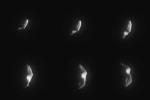 NEAR to Asteroid Eros
28.12.1998
On December 23, the NEAR spacecraft flew by asteroid 433 Eros. NEAR was originally scheduled to brake and orbit Eros, but an unexpected shutdown of its main engine caused this plan to be aborted. NEAR will now be reset and attempt to return to orbit Eros in early 2000.
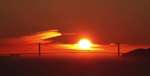 Golden Gate Sunset: Green Flash
2.12.2015
The setting is San Francisco Bay, the time is sunset, and the bridge is the Golden Gate. What you are about to see is an unexpected double sunset ending with a rare green flash.
|
January February March April May June July August September |
|||||||||||||||||||||||||||||||||||||||||||||||||