
|
You entered: hot gas
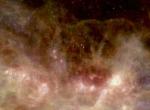 The W4 Chimney
7.02.2000
A huge chimney venting hot clouds of gas out from the plane of our Milky Way Galaxy has recently been imaged in radio waves. The Canadian Galactic Plane Survey team used an array of radio telescopes to survey an ionized gas region known as W4.
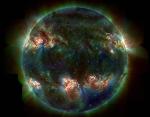 Dark Sun Sizzling
10.07.2006
Is this our Sun? Yes. Even on a normal day, our Sun is sizzling ball of seething hot gas. Unpredictably, regions of strong and tangled magnetic fields arise, causing sunspots and bright active regions. The Sun's surface bubbles as hot hydrogen gas streams along looping magnetic fields.
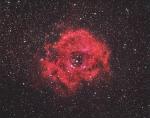 The Rosette Nebula
14.02.1998
Would the Rosette Nebula by any other name look as sweet? The bland New General Catalog designation of NGC 2237 doesn't appear to diminish the appearance of the this flowery emission nebula. Inside the nebula lies an open cluster of bright young stars designated NGC 2244.
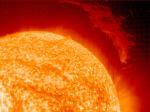 A Prominent Solar Prominence from SOHO
30.03.2004
One of the most spectacular solar sights is a prominence. A solar prominence is a cloud of solar gas held above the Sun's surface by the Sun's magnetic field. Last month, NASA's Sun-orbiting SOHO spacecraft imaged an impressively large prominence hovering over the surface, pictured above.
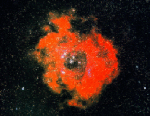 NGC 2237: The Rosette Nebula
14.02.1996
Would the Rosette nebula by any other name look as sweet? The bland New General Catalog designation of NGC 2237 doesn't appear to diminish the appearance of the this flowery emission nebula. Inside the nebula lies an open cluster of bright young stars designated NGC 2244.
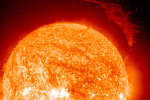 A Prominent Solar Prominence from SOHO
15.03.2009
What's happened to our Sun? It was sporting a spectacular -- but not very unusual -- solar prominence. A solar prominence is a cloud of solar gas held above the Sun's surface by the Sun's magnetic field.
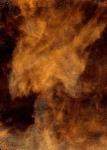 A Galactic Mushroom Cloud
3.02.1999
Part of our Galaxy is exploding. Recent radio observations show new details of hot gas expanding rapidly from an energetic star-forming region in our Galactic disk out into our Galaxy's halo. The combined power of at least hundreds of supernovae is needed to drive this tremendous expansion.
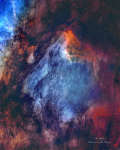 APOD: 2026 September 7 Б The Pelican Nebula in Gas, Dust, and Stars
7.09.2026
The Pelican Nebula is slowly being transformed. IC 5070 (an official designation) is divided from the larger North America Nebula by a molecular cloud filled with dark dust. The deep featured picture from Utah, USA incorporates 25 hours of exposure and brings out great details of this filamentary dust.
 APOD: 2025 October 27 Б Two Tails of Comet Lemmon
27.10.2025
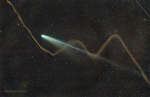
How many bright tails does Comet Lemmon have? Two. In the featured image it appears to have three, but why? The reason is that the zigzagging brown filament is a persistent meteor train that by luck appeared in front of the distant comet C/2025 A6 (Lemmon).
 A Solar Prominence from SOHO
9.11.2005
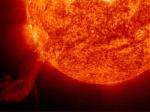
What happened to the Sun? Nothing very unusual: the strange-looking solar appendage on the lower left is actually just a spectacular looking version of a common solar prominence. A solar prominence is a cloud of solar gas held above the Sun's surface by the Sun's magnetic field.
|
January February March April May June July August September |
|||||||||||||||||||||||||||||||||||||||||||||||||