
|
You entered: host galaxy
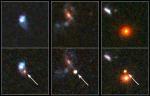 Rumors of a Strange Universe
27.02.2004
Only a few short years ago, when the APOD editors were in graduate school, the pervasive, cosmic Dark Energy was not even seriously discussed. Of course, it now appears that this strange energy dominates the cosmos (as well as lectures on cosmology) and provides a repulsive force accelerating the large scale expansion of the Universe.
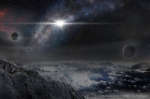 A Candidate for the Biggest Boom Yet Seen
26.01.2016
It is a candidate for the brightest and most powerful explosion ever seen -- what is it? The flaring spot of light was found by the All Sky Automated Survey for Supernovae (ASASSN) in June of last year and labelled ASASSN-15lh.
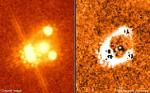 PG 1115: A Ghost of Lensing Past
2.11.1998
In this tangle of quasars and galaxies lies a clue to the expansion rate of the universe. A diffuse glow evident in the picture on the left reveals a normal elliptical galaxy. Directly behind this galaxy lies a normal quasar.
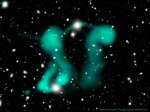 Dancing Ghosts: Curved Jets from Active Galaxies
1.09.2021
Why would galaxies emit jets that look like ghosts? And furthermore, why do they appear to be dancing? The curled and fluffy jets from the supermassive black holes at the centers of two host galaxies (top center and lower left) are unlike anything seen before.
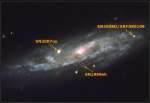 Supernova Factory NGC 2770
18.01.2008
The stellar explosions known as supernovae are among the most powerful events in the universe. Triggered by the collapsing core of a massive star or the nuclear demise of a white dwarf, supernovae occur in average spiral galaxies only about once every century.
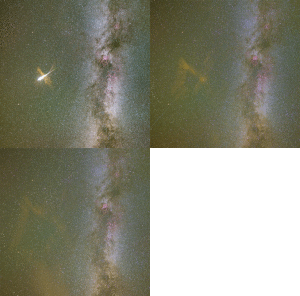 Milky Way and Exploding Meteor
12.08.2015
Tonight the Perseid Meteor Shower reaches its maximum. Grains of icy rock will streak across the sky as they evaporate during entry into Earth's atmosphere. These grains were shed from Comet Swift-Tuttle.
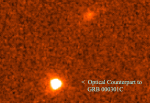 A GRB 000301C Symphony
3.06.2001
Last March, telescopic instruments in Earth and space tracked a tremendous explosion that occurred across the universe. A nearly unprecedented symphony of international observations began abruptly on 2000 March 1 when Earth-orbiting RXTE, Sun-orbiting Ulysses, and asteroid-orbiting NEAR all detected a 10-second burst of high-frequency gamma radiation. Within 48 hours astronomers
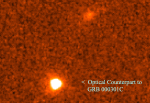 A GRB 000301C Symphony
14.03.2000
Telescopic instruments in Earth and space are still tracking a tremendous explosion that occurred across the universe. A nearly unprecedented symphony of international observations began abruptly on March 1 when Earth-orbiting RXTE, Sun-orbiting Ulysses, and asteroid-orbiting NEAR all detected a 10-second burst of high-frequency gamma radiation.
 APOD: 2026 May 29 Б Messier 104
29.05.2026
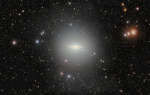
A gorgeous spiral galaxy, Messier 104 is famous for its nearly edge-on profile featuring a broad ring of obscuring dust lanes. Seen in silhouette against an extensive central bulge of stars, the swath of cosmic dust lends a broad brimmed hat-like appearance to the galaxy suggesting a more popular moniker, the Sombrero Galaxy.
 M104: The Sombrero Galaxy
14.05.2021
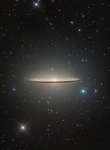
A gorgeous spiral galaxy, M104 is famous for its nearly edge-on profile featuring a broad ring of obscuring dust lanes. Seen in silhouette against an extensive central bulge of stars, the swath of cosmic dust lends a broad brimmed hat-like appearance to the galaxy suggesting a more popular moniker, the Sombrero Galaxy.
|
January February March April May June July August September |
|||||||||||||||||||||||||||||||||||||||||||||||||