
|
You entered: Triangulum
 APOD: 2024 July 14 Б Meteor Misses Galaxy
14.07.2024
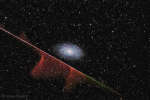
The galaxy was never in danger. For one thing, the Triangulum galaxy (M33), pictured, is much bigger than the tiny grain of rock at the head of the meteor. For another, the galaxy is much farther away -- in this instance 3 million light years as opposed to only about 0.0003 light seconds.
 A Giant Starspot on HD 12545
12.07.2000
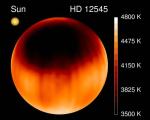
What could cause a star to have such a large spot? Our Sun itself frequently has sunspots, relatively cool dark magnetic depressions that move across its surface. HD 12545, however, exhibits the largest starspots yet observed.
 Meteor Misses Galaxy
30.04.2019
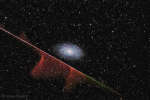
The galaxy was never in danger. For one thing, the Triangulum galaxy (M33), pictured, is much bigger than the tiny grain of rock at the head of the meteor. For another, the galaxy is much farther away -- in this instance 3 million light years as opposed to only about 0.0003 light seconds.
 A Giant Starspot on HD 12545
2.11.2003
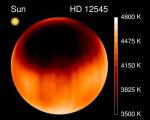
What could cause a star to have such a large spot? Our Sun itself frequently has sunspots, relatively cool dark magnetic depressions that move across its surface. HD 12545, however, exhibits the largest starspots yet observed.
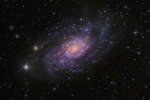 NGC 2403 in Camelopardalis
26.03.2015
Magnificent island universe NGC 2403 stands within the boundaries of the long-necked constellation Camelopardalis. Some 10 million light-years distant and about 50,000 light-years across, the spiral galaxy also seems to have more than its fair share of giant star forming HII regions, marked by the telltale reddish glow of atomic hydrogen gas.
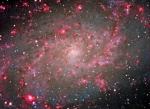 Hydrogen in M33
23.11.2006
Gorgeous spiral galaxy M33 seems to have more than its fair share of hydrogen. Its inner 30,000 light-years are shown here in an image processed to fully reveal the reddish glow of ionized hydrogen regions (HII regions) sprawling along loose spiral arms as they wind toward the galaxy's core.
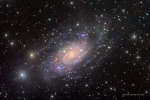 NGC 2403 in Camelopardalis
19.02.2016
Magnificent island universe NGC 2403 stands within the boundaries of the long-necked constellation Camelopardalis. Some 10 million light-years distant and about 50,000 light-years across, the spiral galaxy also seems to have more than its fair share of giant star forming HII regions, marked by the telltale reddish glow of atomic hydrogen gas.
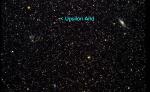 Where is Upsilon Andromedae
22.04.1999
Astronomers recently announced the detection of three large planets orbiting the star Upsilon Andromedae - the first planetary system known to orbit a normal star other than our Sun. These planets were not directly photographed but found through a Doppler technique developed to use large telescopes to search nearby stars for wobbling planetary signatures.
 Elements of Nearby Spiral M33
27.09.2001
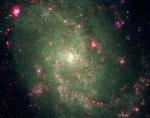
Spiral galaxy M33 is a mid-sized member of our Local Group of Galaxies. M33 is also called the Triangulum Galaxy for the constellation in which it resides. About four times smaller (in radius) than...
 The Milky Way Sets
26.08.2016
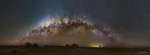
Under dark skies the setting of the Milky Way can be a dramatic sight. Stretching nearly parallel to the horizon, this rich, edge-on vista of our galaxy above the dusty Namibian desert stretches from bright, southern Centaurus (left) to Cepheus in the north (right).
|
January February March April May June July August September |
|||||||||||||||||||||||||||||||||||||||||||||||||