
|
You entered: O star
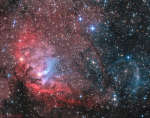 The Tulip and Cygnus X-1
1.09.2022
Framing a bright emission region, this telescopic view looks out along the plane of our Milky Way Galaxy toward the nebula rich constellation Cygnus the Swan. Popularly called the Tulip Nebula, the reddish glowing cloud of interstellar gas and dust is also found in the 1959 catalog by astronomer Stewart Sharpless as Sh2-101.
 APOD: 2024 August 28 Б Tulip Nebula and Black Hole Cygnus X 1
28.08.2024
When can you see a black hole, a tulip, and a swan all at once? At night -- if the timing is right, and if your telescope is pointed in the right direction. The complex and beautiful Tulip Nebula blossoms about 8,000 light-years away toward the constellation of Cygnus the Swan.
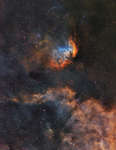 The Tulip and Cygnus X 1
29.07.2021
This tall telescopic field of view looks out along the plane of our Milky Way Galaxy toward the nebula rich constellation Cygnus the Swan. Popularly called the Tulip Nebula, the brightest glowing cloud of interstellar gas and dust above center is also found in the 1959 catalog by astronomer Stewart Sharpless as Sh2-101.
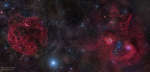 Downtown Auriga
13.02.2014
Rich in star clusters and nebulae, the ancient constellation of Auriga, the Charioteer, rides high in northern winter night skies. Spanning nearly 24 full moons (12 degrees) on the sky, this deep telescopic mosaic view recorded in January shows off some of Auriga's most popular sights for cosmic tourists.
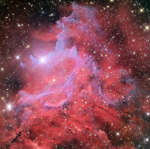 Flaming Star Nebula
1.12.2016
A runaway star lights the Flaming Star Nebula in this cosmic scene. Otherwise known as IC 405, the Flaming Star Nebula's billowing interstellar clouds of gas and dust lie about 1,500 light-years away toward the constellation of Auriga.
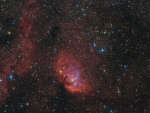 The Tulip in the Swan
21.09.2019
Framing a bright emission region, this telescopic view looks out across a pretty field of stars along the plane of our Milky Way Galaxy, toward the nebula rich constellation Cygnus the Swan. Popularly called...
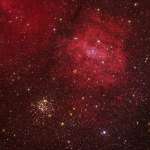 The Bubble and M52
30.10.2009
To the eye, this cosmic composition nicely balances the Bubble Nebula at the upper right with open star cluster M52. The pair would be lopsided on other scales, though. Embedded in a complex...
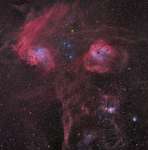 Aurigae Nebulae
24.02.2012
Rich in star clusters and nebulae, the ancient constellation of Auriga, the Charioteer, rides high in northern winter night skies. Composed from narrow and broadband filter data and spanning nearly 8 Full Moons (4 degrees) on the sky, this deep telescopic view recorded in January shows off some of Auriga's celestial bounty.
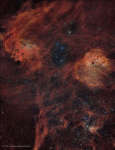 Nebulae in Aurigae
1.12.2015
Rich in star clusters and nebulae, the ancient constellation of the Charioteer (Auriga) rides high in northern winter night skies. Composed from narrow and broadband filter data and spanning nearly 8 Full Moons (4 degrees) on the sky, this deep telescopic view shows off some of Auriga's celestial bounty.
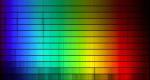 Stellar Spectral Types: OBAFGKM
18.04.2004
Astronomers divide stars into different spectral types. First started in the 1800s, the spectral type was originally meant to classify the strength of hydrogen absorption lines. A few types that best describe the temperature of the star remain in use today.
|
January February March April May June July August September October |
|||||||||||||||||||||||||||||||||||||||||||||||||