
|
You entered: Gemini North
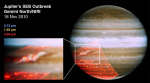 Dark Belt Reappearing on Jupiter
29.11.2010
Why are planet-circling clouds disappearing and reappearing on Jupiter? Although the ultimate cause remains unknown, planetary meteorologists are beginning to better understand what is happening. Earlier this year, unexpectedly, Jupiter's dark Southern Equatorial Belt (SEB) disappeared. The changes were first noted by amateurs dedicated to watching Jupiter full time.
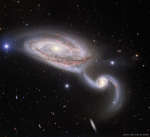 The Slow Dance of Galaxies NGC 5394 and 5395
4.03.2020
If you like slow dances, then this may be one for you. A single turn in this dance takes several hundred million years. Two galaxies, NGC 5394 and NGC 5395, slowly whirl about each other in a gravitational interaction that sets off a flourish of sparks in the form of new stars.
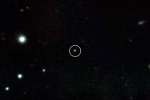 GRB 090423: The Farthest Explosion Yet Measured
29.04.2009
An explosion so powerful it was seen clear across the visible universe was recorded in gamma-radiation last week by NASA's orbiting Swift Observatory. Farther than any known galaxy, quasar, or optical supernova, the gamma-ray burst recorded last week was clocked at redshift 8.2, making it the farthest explosion of any type yet detected.
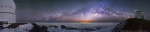 Mauna Kea Milky Way Panorama
19.02.2009
Aloha and welcome to a breathtaking skyscape. The dreamlike panoramic view looks out from the 4,200 meter volcanic summit of Mauna Kea, Hawai'i, across a layer of clouds toward a starry night sky and the rising Milky Way.
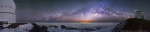 Milky Way Panorama from Mauna Kea
10.03.2013
Aloha and welcome to a breathtaking skyscape. The dreamlike panoramic view looks out from the 4,200 meter volcanic summit of Mauna Kea, Hawai'i, across a layer of clouds toward a starry night sky and the rising Milky Way.
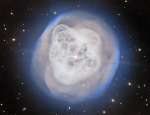 APOD: 2026 May 28 Б NGC 1514: The Crystal Ball Nebula
28.05.2026
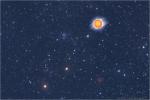
What do you see in this crystal ball? The featured image shows NGC 1514, known as the Crystal Ball Nebula, observed by the Gemini North telescope on Maunakea, in Hawai'i. NGC 1514 is 1,500 light-years away and was discovered by William Herschel in 1790.
 APOD: 2025 July 17 Б 3I/ATLAS
17.07.2025
Discovered on July 1 with the NASA-funded ATLAS (Asteroid Terrestrial-impact Last Alert, System) survey telescope in Rio Hurtado, Chile, 3I/ATLAS is so designated as the third known interstellar object to pass through our Solar System It follows 1I/йOumuamua in 2017 and the comet 2I/Borisov in 2019.
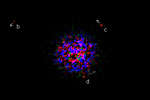 HR 8799: Discovery of a Multi planet Star System
17.11.2008
How common are planetary systems like our own Solar System? In the twelve years previous to 2008, over 300 candidate planetary systems have been found orbiting nearby stars. None, however, were directly imaged, few showed evidence for multiple planets, and many had a Jupiter-sized planet orbiting inside the orbit of Mercury.
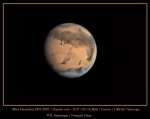 Mars in View
6.12.2007
Very good telescopic views of Mars can be expected in the coming weeks as the Red Planet nears opposition on December 24th. Of course, opposition means opposite the Sun in planet Earth's sky - an arrangement that occurs every 26 months for Mars.
 Stars and the Solstice Sun
21.06.2007
If you could turn off the atmosphere's ability to scatter overwhelming sunlight, today's daytime sky might look something like this ... with the Sun surrounded by the stars of the constellations Taurus and Gemini. Of course, today is the Solstice.
|
January February March April May June July August |
||||||||||||||||||||||||||||||||||||||||||||||||||||||||