
|
You entered: Galilean Moon
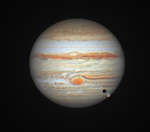 In Ganymede s Shadow
7.10.2022
At opposition, opposite the Sun in Earth's sky, late last month Jupiter is also approaching perihelion, the closest point to the Sun in its elliptical orbit, early next year. That makes Jupiter exceptionally close to our fair planet, currently resulting in excellent views of the Solar System's ruling gas giant.
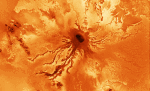 Closeup of an Io Volcano
4.08.1995
In 1979, one of NASA's Voyager spacecraft made a spectacular and unexpected discovery. Io, the innermost Galilean moon of Jupiter, was covered with volcanoes and some of them were erupting! In all, Voyager 1 observed nine volcanic eruptions during its encounter with the moon.
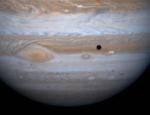 Jupiter, Io, and Shadow
7.12.2002
Pictured above is the innermost of Jupiter's Galilean satellites, Io, superposed in front of the gas giant planet. To the left of Io is a dark spot that is Io's own shadow. A solar eclipse would be seen from within the shadow spot on Jupiter.
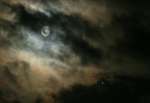 Moons and Jupiter
14.07.2009
Earth's Moon and planet Jupiter made a beautiful pairing in the night sky late last week. This skyscape recorded on July 11 from Brittany in north western France captures the bright conjunction through a cloud bank.
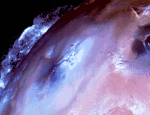 Erupting Volcanoes on Io
5.08.1996
Jupiter's moon Io has active volcanoes. The Voyager spacecraft caught several erupting when they passed the energetic moon in 1979. In the above picture, several of Io's volcanoes are visible and one is seen actually erupting.
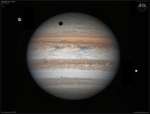 Ganymede s Shadow
25.03.2017
Approaching opposition early next month, Jupiter is offering some of its best telescopic views from planet Earth. On March 17, this impressively sharp image of the solar system's ruling gas giant was taken from a remote observatory in Chile.
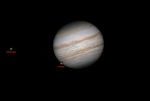 Jupiter Rotates as Moons Orbit
25.10.2022
Jupiter and its moons move like our Sun and its planets. Similarly, Jupiter spins while its moons circle around. JupiterБs rotation can be observed by tracking circulating dark belts and light zones. The Great Red Spot, the largest storm known, rotates to become visible after about 15 seconds in the 48-second time lapse video.
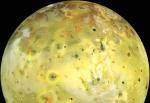 Io in True Color
15.07.2001
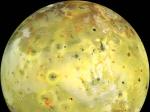
The strangest moon in the Solar System is bright yellow. This picture, showing Io's true colors, was taken in 1999 July by the Galileo spacecraft currently orbiting Jupiter. Io's colors derive from sulfur and molten silicate rock. The unusual surface of Io is kept very young by its system of active volcanoes.
 Io in True Color
2.05.2004
The strangest moon in the Solar System is bright yellow. This picture, showing Io's true colors, was taken in 1999 July by the Galileo spacecraft that orbited Jupiter from 1995 to 2003. Io's colors derive from sulfur and molten silicate rock.
 Moons at Twilight
4.02.2022
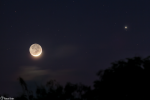
Even though Jupiter was the only planet visible in the evening sky on February 2, it shared the twilight above the western horizon with the Solar System's brightest moons. In a single exposure...
|
January February |
|||||||||||||||||||||||||||||||||||||||||||||||||