
|
You entered: Egg Nebula
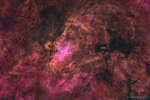 Nest of the Eagle Nebula
4.10.2016
What surrounds the famous Eagle Nebula? The inside of the Eagle Nebula contains eggs -- evaporating gaseous globules -- that typically reside in tremendous pillars of gas and dust and where stars form. This image, though...
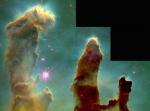 M16: Stars from Eagle's EGGs
25.11.2001
Newborn stars are forming in the Eagle Nebula. This image, taken with the Hubble Space Telescope in 1995, shows evaporating gaseous globules (EGGs) emerging from pillars of molecular hydrogen gas and dust. The giant pillars are light years in length and are so dense that interior gas contracts gravitationally to form stars.
 M16: Stars from Eagle's Eggs
24.09.2000
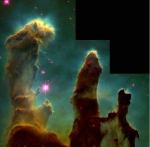
Newborn stars are forming in the Eagle Nebula. This image, taken with the Hubble Space Telescope in 1995, shows evaporating gaseous globules (EGGs) emerging from pillars of molecular hydrogen gas and dust. The giant pillars are light years in length and are so dense that
 M16: Stars from Eagles EGGs
26.10.2003
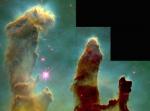
Newborn stars are forming in the Eagle Nebula. This image, taken with the Hubble Space Telescope in 1995, shows evaporating gaseous globules (EGGs) emerging from pillars of molecular hydrogen gas and dust. The giant pillars are light years in length and are so dense that interior gas contracts gravitationally to form stars.
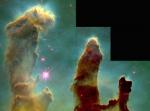 M16: Stars from Eagle's EGGs
24.04.2005
Newborn stars are forming in the Eagle Nebula. This image, taken with the Hubble Space Telescope in 1995, shows evaporating gaseous globules (EGGs) emerging from pillars of molecular hydrogen gas and dust. The giant pillars are light years in length and are so dense that interior gas contracts gravitationally to form stars.
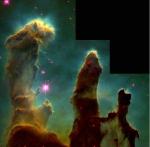 Stars from Eagle's EGGs
12.04.1998
Newborn stars are forming in the Eagle Nebula. This image, taken with the Hubble Space Telescope in 1995, shows evaporating gaseous globules (EGGs) emerging from pillars of molecular hydrogen gas and dust. The giant pillars are light years in length and are so dense that interior gas contracts gravitationally to form stars.
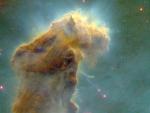 Eagle EGGs in M16
12.08.2001
Star forming regions known as "EGGs" are uncovered at the end of this giant pillar of gas and dust in the Eagle Nebula (M16). EGGs, short for evaporating gaseous globules, are dense regions of mostly molecular hydrogen gas that fragment and gravitationally collapse to form stars.
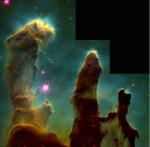 Stars from Eagles Eggs
2.05.1999
Newborn stars are forming in the Eagle Nebula. This image, taken with the Hubble Space Telescope in 1995, shows evaporating gaseous globules (EGGs) emerging from pillars of molecular hydrogen gas and dust. The giant pillars are light years in length and are so dense that interior gas contracts gravitationally to form stars.
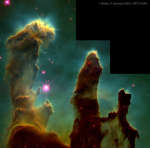 M16: Pillars of Star Creation
6.12.2020
These dark pillars may look destructive, but they are creating stars. This pillar-capturing image of the inside of the Eagle Nebula, taken with the Hubble Space Telescope in 1995, shows evaporating gaseous globules (EGGs) emerging from pillars of molecular hydrogen gas and dust.
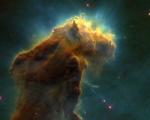 Eagle Eggs in M16
28.02.1998
Star forming regions known as "EGGs" are uncovered at the end of this giant pillar of gas and dust in the Eagle Nebula (M16). EGGs, short for evaporating gaseous globules, are dense regions of mostly molecular hydrogen gas that fragment and gravitationally collapse to form stars.
|
January February March April May June July August |
||||||||||||||||||||||||||||||||||||||||||||||||||||||||