
|
You entered: Earth's rotation
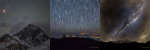 Highest, Tallest, and Closest to the Stars
25.02.2016
Fans of planet Earth probably recognize its highest mountain, the Himalayan Mount Everest, on the left in this 3-panel skyscape of The World at Night. Shrouded in cloud Everest's peak is at 8,848 meters (29,029 feet) elevation above sea level.
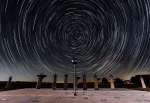 Star Trails and the Bracewell Radio Sundial
13.07.2018
Sundials use the location of a shadow to measure the Earth's rotation and indicate the time of day. So it's fitting that this sundial, at the Very Large Array Radio Telescope Observatory in New Mexico, commemorates the history of radio astronomy and radio astronomy pioneer Ronald Bracewell.
 A Time Lapse Lunar Eclipse
3.11.2004
During last week's lunar eclipse, our Moon appeared to disappear. As the Earth moved between the Moon and the Sun, the Earth's shadow fell on the moon, making it quite dark.
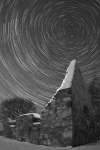 Star Trails in the North
24.12.2010
Pointing skyward, the wall of this ruined Viking church still stands after a thousand winters, near the town of Vallentuna, Sweden. The time exposure records the scene on December 14th as stars leave graceful arcing trails during a long night, reflecting planet Earth's daily rotation on its axis.
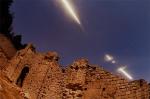 A Lunar Eclipse Over Time
26.01.2000
During last week's lunar eclipse, our Moon appeared to disappear. As the Earth moved between the Moon and the Sun, the Earth's shadow fell on the moon, making it quite dark. In the above photograph, the Earth's rotation caused the Moon and stars to appear as streaks during this four-hour exposure.
 A Total Lunar Eclipse Over North Carolina
26.08.2007
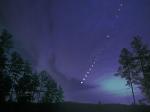
This coming Tuesday, our Moon will appear to disappear. A similar total lunar eclipse is seen above in a time lapse image captured in 2003 over North Carolina, USA. As the Earth moves between the Moon and the Sun, the Earth's shadow fell on the moon, making it quite dark.
 Jupiters Magnetic Field from Juno
25.02.2020
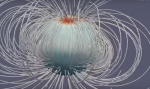
How similar is Jupiter's magnetic field to Earth's? NASA's robotic Juno spacecraft has found that Jupiter's magnetic field is surprisingly complex, so that the Jovian world does not have single magnetic poles like our Earth.
 Rotating Moon from LRO
18.03.2018
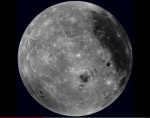
No one, presently, sees the Moon rotate like this. That's because the Earth's moon is tidally locked to the Earth, showing us only one side. Given modern digital technology, however, combined with many detailed images returned by the Lunar Reconnaissance Orbiter (LRO), a high resolution virtual Moon rotation movie has been composed.
 APOD: 2024 June 2 Б Rotating Moon from LRO
2.06.2024
No one, presently, sees the Moon rotate like this. That's because the Earth's moon is tidally locked to the Earth, showing us only one side. Given modern digital technology, however, combined with many detailed images returned by the Lunar Reconnaissance Orbiter (LRO), a high resolution virtual Moon rotation movie has been composed.
 Rotating Moon from LRO
19.07.2020
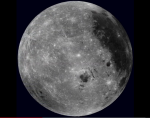
No one, presently, sees the Moon rotate like this. That's because the Earth's moon is tidally locked to the Earth, showing us only one side. Given modern digital technology, however, combined with many detailed images returned by the Lunar Reconnaissance Orbiter (LRO), a high resolution virtual Moon rotation movie has been composed.
|
January February March April May June July August September October |
|||||||||||||||||||||||||||||||||||||||||||||||||