
|
You entered: Earth
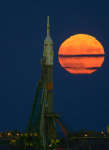 Soyuz vs Supermoon
16.11.2016
Faster than a speeding bullet, more powerful than a locomotive, and able to leap tall buildings in a single bound, this Soyuz rocket stands on the launch pad at Baikonur Cosmodrome in Kazakhstan on November 14.
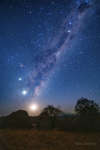 Moon, Four Planets, and Emu
7.02.2019
A luminous Milky Way falls toward the horizon in this deep skyscape, starting at the top of the frame from the stars of the Southern Cross and the dark Coalsack Nebula. Captured...
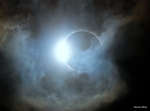 Diamond in the Sky
17.12.2020
When the shadow of the Moon raced across planet Earth's southern hemisphere on December 14, sky watchers along the shadow's dark central path were treated to the only total solar eclipse of 2020. During the New Moon's shadow play this glistening diamond ring was seen for a moment, even in cloudy skies.
 Meteors along the Milky Way
23.08.2023
Under dark and mostly moonless night skies, many denizens of planet Earth were able to watch this year's Perseid meteor shower. Seen from a grassy hillside from Shiraz, Iran these Perseid meteors streak along the northern summer Milky Way before dawn on Sunday, August 13.
 NGC 7293: The Helix Nebula
23.10.2024
A mere seven hundred light years from Earth toward the constellation Aquarius, a star is dying. The once sun-like star's last few thousand years have produced the Helix Nebula. Also known...
 APOD: 2025 April 30 Б A Happy Sky over Bufa Hill in Mexico
29.04.2025
Sometimes, the sky itself seems to smile. A few days ago, visible over much of the world, an unusual superposition of our Moon with the planets Venus and Saturn created just such an iconic facial expression.
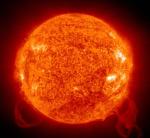 Double Eruptive Prominences
18.04.2003
Lofted over the Sun on looping magnetic fields, large solar prominences are composed of relatively cool, dense plasma. When seen against the brilliant solar disk they appear as dark filaments, but these enormous magnetic...
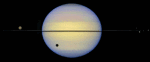 Saturn's Rings Seen Sideways
24.05.1997
Saturn's rings are actually very thin. This picture from the Hubble Space Telescope was taken on August 6, 1995 when the rings lined up sideways as seen from Earth. Saturn's largest moon Titan is seen on the left, and Titan's shadow can be seen on Saturn's cloud tops!
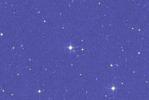 A Planet For Gliese 876
26.06.1998
Centered in this unremarkable, 1/4 degree wide patch of sky in the constellation Aquarius is the star Gliese 876. Gliese 876 is smaller than the Sun, only about 1/3 as massive, and too faint to be seen without a telescope. But it is known to be one of the nearest stars, only 15 light-years distant.
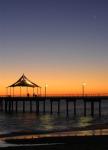 Three Planets by the Sea
2.07.2005
On Tuesday, June 28th, the setting Sun flooded the horizon with a beautiful warm light in this view from the beach beside the pier at Brighton in Adelaide, South Australia. The Sun also illuminated three planets gathered in the western sky, Mercury, Venus, and Saturn.
|
January February |
|||||||||||||||||||||||||||||||||||||||||||||||||