
|
You entered: planets
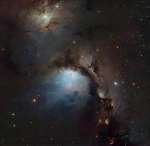 Hidden Treasures of M78
27.01.2011
M78 isn't really hiding in planet Earth's night sky. About 1,600 light-years away and nestled in the nebula rich constellation Orion, the large, bright, reflection nebula is well-known to telescopic skygazers. But this gorgeous image of M78 was selected as the winner of the Hidden Treasures 2010 astrophotography competition.
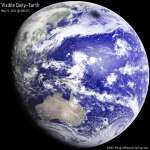 Looking Back at an Eclipsed Earth
30.05.2012
What's that dark spot on planet Earth? It's the shadow of the Moon. The above image of Earth was taken last week by MTSAT during an annular eclipse of the Sun. The dark spot appears quite unusual as clouds are white and the oceans are blue in this color corrected image.
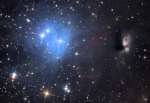 Reflection Nebula vdB1
26.10.2012
Every book has a first page and every catalog a first entry. And so this lovely blue cosmic cloud begins the van den Bergh Catalog (vdB) of stars surrounded by reflection nebulae. Interstellar dust...
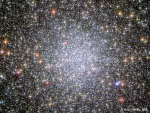 Globular Star Cluster 47 Tuc
19.05.2015
Globular star cluster 47 Tucanae is a jewel box of the southern sky. Also known as NGC 104, it roams the halo of our Milky Way Galaxy along with over 150 other globular star clusters.
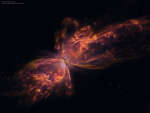 The Butterfly Nebula from Hubble
8.02.2017
The bright clusters and nebulae of planet Earth's night sky are often named for flowers or insects. Though its wingspan covers over 3 light-years, NGC 6302 is no exception. With an estimated surface...
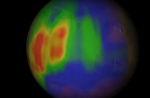 Mars Methane Mystery Deepens
22.04.2019
The methane mystery on Mars just got stranger. New results from ESA and Roscosmos' ExoMars Trace Gas Orbiter, has unexpectedly not detected methane in the atmosphere of Mars. This result follows the 2013 detection of methane by NASA's Curiosity rover, a result seemingly confirmed by ESA's orbiting Mars Express the next day.
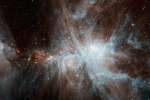 Spitzer's Orion
31.08.2019
Few cosmic vistas excite the imagination like the Orion Nebula, an immense stellar nursery some 1,500 light-years away. Spanning about 40 light-years across the region, this infrared image from the Spitzer Space Telescope...
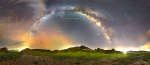 Perseids Around the Milky Way
17.08.2020
Why would meteor trails appear curved? The arcing effect arises only because the image artificially compresses (nearly) the whole sky into a rectangle. The meteors are from the Perseid Meteor Shower that peaked last week.
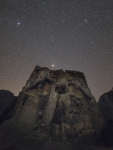 Mars, Pleiades, and Andromeda over Stone Lions
13.10.2020
Three very different -- and very famous -- objects were all captured in a single frame last month. On the upper left is the bright blue Pleiades, perhaps the most famous cluster of stars on the night sky. The Pleiades (M45) is about 450 light years away and easily found a few degrees from Orion.
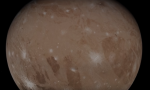 Juno Flyby of Ganymede and Jupiter
11.10.2021
What would it be like to fly over the largest moon in the Solar System? In June, the robotic Juno spacecraft flew past Jupiter's huge moon Ganymede and took images that have been digitally constructed into a detailed flyby.
|
January February |
|||||||||||||||||||||||||||||||||||||||||||||||||